My Security Deposit Wasn't Returned. Here's the Calm, Step-by-Step Plan
Security deposit not returned after move-out? Find your state's rules, gather proof, send a written request, and learn when small claims court fits.
“Nearly re-enrolled in English class while reading a lease.”
Theology · Scripture Cards
Open a scripture card
Already read and shared by 315 people.
 The God Who Brought You Out
Exodus 20:2
“I am Yahweh your God, who brought you out of the land of Egypt, out of the house of bondage.
Read this card
 Let There Be Light
Genesis 1:3-4
God said, “Let there be light,” and there was light. God saw the light, and saw that it was good. God divided the light from the darkness.
Read this card
 Twelve Baskets Left Over
John 6:11, 13
Jesus took the loaves, and having given thanks, he distributed to the disciples, and the disciples to those who were sitting down, likewise…
Read this card
 In the Name of the Lord
1 Samuel 17:45, 47
Then David said to the Philistine, “You come to me with a sword, with a spear, and with a javelin; but I come to you in the name of Yahweh…
Read this card
 While He Was Still a Long Way Off
Luke 15:20, 22
“He arose and came to his father. But while he was still far off, his father saw him and was moved with compassion, and ran, fell on his…
Read this card
 This Is My Beloved Son
Matthew 3:16-17
Jesus, when he was baptized, went up directly from the water: and behold, the heavens were opened to him. He saw the Spirit of God…
Read this card
 Surely I Will Be with You
Judges 6:16
Yahweh said to him, “Surely I will be with you, and you shall strike the Midianites as one man.”
Read this card
 I Am with You Always
Matthew 28:20
teaching them to observe all things that I commanded you. Behold, I am with you always, even to the end of the age.” Amen.
Read this card
Key Takeaways
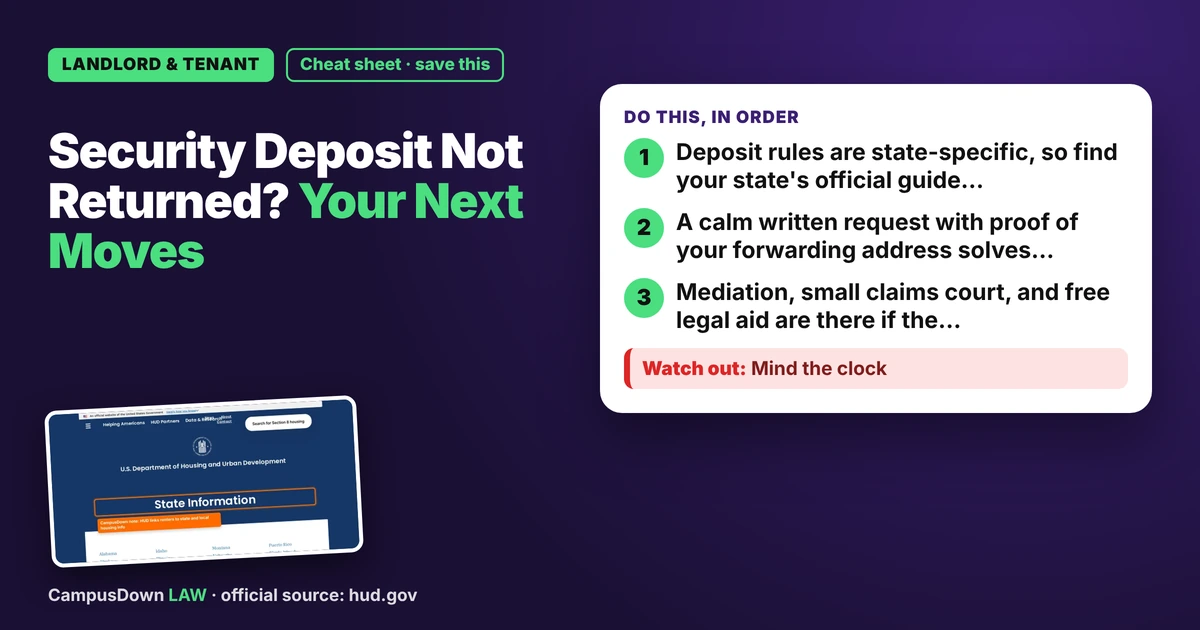
- Deposit rules are state-specific, so find your state's official guide first.
- A calm written request with proof of your forwarding address solves many cases.
- Mediation, small claims court, and free legal aid are there if the landlord doesn't respond.
General information, not legal advice. Rules vary by state and can change; check the official sources linked in this guide.
I moved out, scrubbed the oven like it owed me money, returned the keys, and then... nothing. No check, no email, no "here's what we kept and why." If your security deposit was not returned and you're watching your bank app like it's a crush's read receipt, this one's for you.
This is general information, not legal advice. Deposit rules are mostly set by states (and sometimes cities), so the exact deadline and the exact rules for deductions depend on where you rented. What I can give you is the order of operations that keeps you calm, organized, and taken seriously.
Step 1: Find the rule that actually applies to you
Before you write anything angry, find your state's official deposit rules. Look for three things: how long the landlord has to return the deposit after move-out, whether they must send a written, itemized list of deductions, and what happens if they don't. Your state attorney general's site, your state court's self-help pages, or local legal aid usually explain this in plain English.
HUD has a state-by-state resource page that points you to housing information and local contacts. It's a good starting map when you don't even know which office to search for.
One mindset trap here: hindsight bias will make you think "I should've known all this before I signed." Maybe. But nobody reads a lease at 19 like a lawyer. Start from today.
Step 2: Gather your proof before your memory blurs
Pull together everything that shows what you paid and what condition you left the place in:
- Your lease (the deposit amount and any move-out clauses)
- Proof you paid the deposit: bank record, receipt, or app payment
- Move-in and move-out photos or video, ideally with dates
- Any move-in checklist you or the landlord filled out
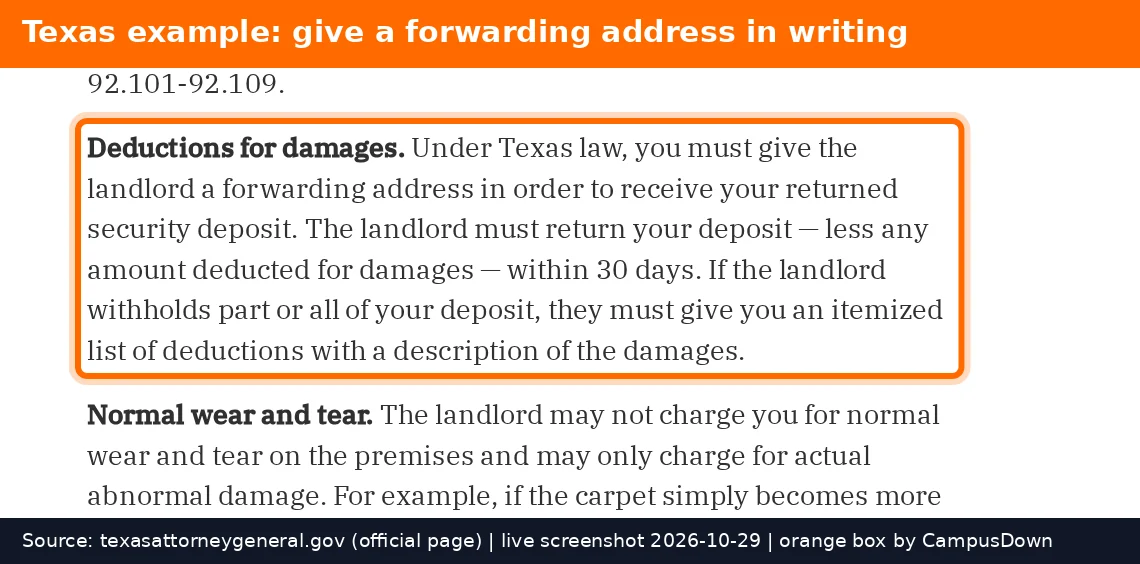
- Your forwarding address, and proof you gave it to the landlord
- Texts or emails about move-out, keys, cleaning, or repairs
If your photos aren't great, that's okay. Use what you have, and write down the condition of each room while you still remember it. Put the date on your notes.
Step 3: Ask in writing, calmly
A short, polite written request often works better than ten angry texts. Include your name, the rental address, your move-out date, the deposit amount, your forwarding address, and a clear ask: return the deposit, or send an itemized list of any deductions, by a specific reasonable date. Keep a copy and use a delivery method you can prove, like certified mail or an email you saved.
This is also basic negotiation theory: you're giving the other side an easy, face-saving way to fix it. Plenty of landlords just forgot, or mailed the check to your old address.
Step 4: If they deducted money, compare the list to your proof
Many states separate normal wear and tear (stuff that happens with ordinary living) from damage beyond that. Your state's official guide will say how it draws the line. Go line by line: for each deduction, do you have a photo, receipt, or message that shows otherwise? If yes, say so in your reply, attach it, and ask for that amount back.
Watch out for anchoring. The first number the landlord throws out can make a fair amount feel unreasonable to ask for. Base your number on your evidence, not on their first offer.
Step 5: Small claims, mediation, or legal help
If the deadline passes and you get nothing, or the deductions don't hold up, you still have options. Many cities and courts offer free mediation. Small claims court exists for exactly this size of dispute, and court self-help centers explain how to file. If you're a student, check whether your school offers student legal services. Free legal aid offices can also tell you about local rules, like penalties some places add when a deposit is wrongly kept.
It feels small and petty to chase money you already paid, but it's your money. Thinking in terms of loss aversion helps: losing the deposit stings more than winning the same amount would feel good, and that sting can make you either rage or give up. Do neither. Follow the steps.
Need a different letter for a related problem? The complaint letter templates hub has them all in one place, including a copy-paste consumer complaint letter.
Know someone stuck with a landlord or billing problem? Pass this along.
Pick an app — it just sends the link, nothing else.
Frequently Asked Questions
What should I do first if my security deposit isn't returned?
Find your state's official deposit rules (deadline and itemization requirements), then send your landlord a short written request with your forwarding address and a reasonable response date.
Can a landlord keep my deposit for normal wear and tear?
Many states don't allow deductions for ordinary wear and tear, only for damage beyond it, unpaid rent, or other items the law allows. Check your state's official guide for the exact rule.
Do I need photos to get my deposit back?
Photos aren't the only proof, but dated move-in and move-out photos are some of the strongest evidence a renter can have.
Can I sue my landlord in small claims for my deposit?
In most places, yes. Small claims courts handle disputes like this, and court self-help centers explain filing. This is general information, not legal advice.