Consumer Grievance Letter: How to Escalate When Support Says No
A consumer grievance letter for when support already failed: who to address it to, a copy-paste escalation template, and where to go next, CFPB to state AG.
“Nearly re-enrolled in English class while reading a lease.”
Theology · Scripture Cards
Open a scripture card
Already read and shared by 315 people.
 Surely I Will Be with You
Judges 6:16
Yahweh said to him, “Surely I will be with you, and you shall strike the Midianites as one man.”
Read this card
 For Such a Time as This
Esther 4:14
For if you remain silent now, then relief and deliverance will come to the Jews from another place, but you and your father’s house will…
Read this card
 Peace, Be Still
Mark 4:39, 41
He awoke and rebuked the wind, and said to the sea, “Peace! Be still!” The wind ceased and there was a great calm. … They were greatly…
Read this card
 The Lord Will Provide
Genesis 22:14
Abraham called the name of that place “Yahweh Will Provide”. As it is said to this day, “On Yahweh’s mountain, it will be provided.”
Read this card
 Take Heart, It Is I
Matthew 14:27, 31
But immediately Jesus spoke to them, saying, “Cheer up! It is I! Don’t be afraid.” … Immediately Jesus stretched out his hand, took hold of…
Read this card
 Daughter, Your Faith Has Healed You
Mark 5:34
He said to her, “Daughter, your faith has made you well. Go in peace, and be cured of your disease.”
Read this card
 I Will Put Breath in You
Ezekiel 37:5-6
The Lord Yahweh says to these bones: “Behold, I will cause breath to enter into you, and you will live. I will lay sinews on you, and will…
Read this card
 I Am with You
Genesis 28:15
Behold, I am with you, and will keep you, wherever you go, and will bring you again into this land. For I will not leave you until I have…
Read this card
Key Takeaways
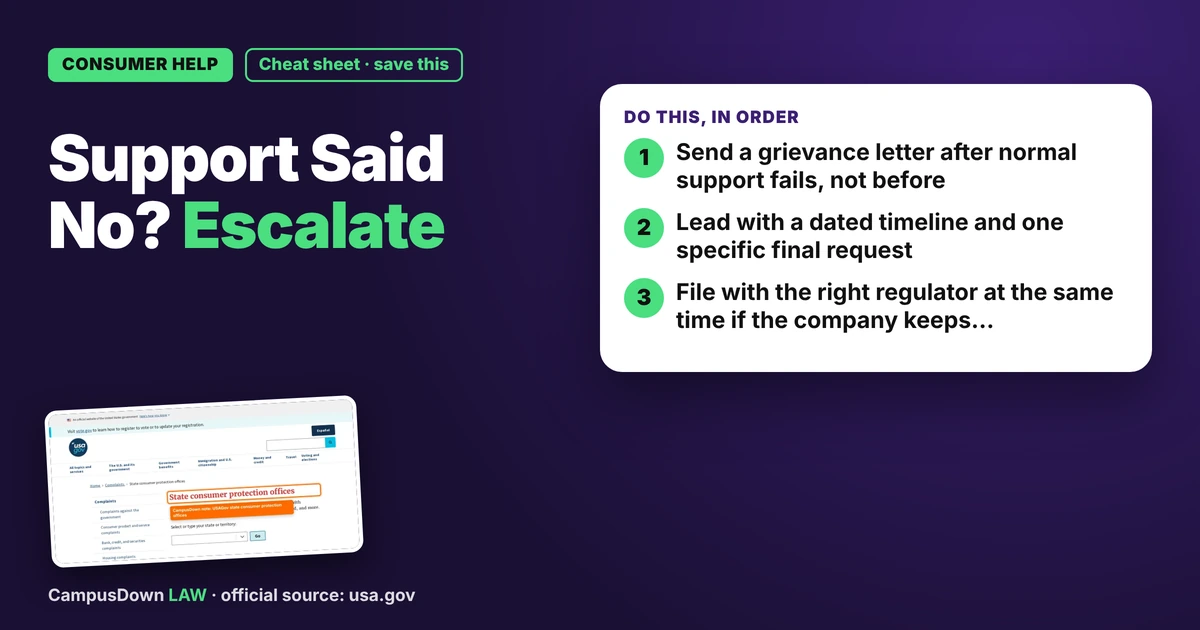
- Send a grievance letter after normal support fails, not before.
- Lead with a dated timeline and one specific final request.
- File with the right regulator at the same time if the company keeps stalling.
General information, not legal advice. Rules vary by state and can change; check the official sources linked in this guide.
You already did the polite thing. You called, you chatted, you got a ticket number and a "we've escalated this," and then nothing. A consumer grievance letter is what you send next: not the first complaint, but the one that goes over the support queue to someone who can actually say yes.
Quick note: I'm a student, not a lawyer. This is general info, not legal advice, and rules vary by state.
Complaint letter vs. grievance letter
Your first letter asks the company to fix a problem. If you haven't sent one yet, start with the consumer complaint letter templates instead. A grievance letter comes after that. It says: I asked, here's the record of me asking, it didn't get fixed, and I'm now raising it formally. The tone shifts from "please help" to "here's the timeline, here's my final request."
That timeline is the whole point. It's a lot like escalation of commitment in reverse: you're not throwing more energy at a dead end, you're moving the problem up to someone with more authority.
Who to address it to
- A named escalation team.* Many companies list an "executive customer relations," "office of the president," or formal complaints address on their site, in their terms, or on your bill. Use it if it exists.
- The notice address in your contract.* Some agreements say where formal notices must go. If yours does, send it there.
- A regulator, at the same time.* For banks, cards, loans, credit reports and debt collectors, that's the CFPB. For most other businesses, it's your state consumer protection office or attorney general.
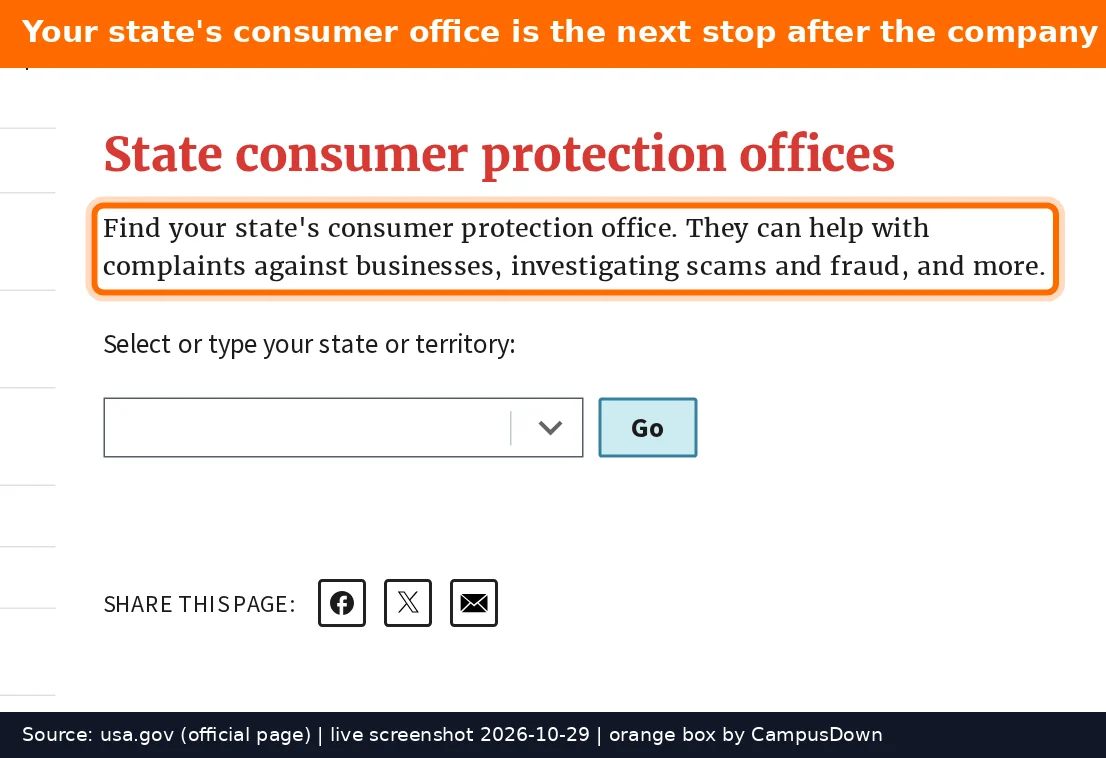
USAGov keeps a directory of state consumer protection offices. Pick your state and it points you to the office that handles complaints against businesses.
The grievance letter template
Copy this and replace every bracket:
[Your name], [address], [email/phone] [Date]
[Company name], Attn: [Executive Customer Relations / Formal Complaints] Re: Formal grievance, account [last 4 digits], previous case numbers [#, #]
I'm writing to formally escalate an unresolved problem. On [date] I [bought / was billed for] [item/service]. The problem: [one or two sentences].
What I've already done:
- [Date]: [phone/chat/email], case [#], told [what they said]
- [Date]: written complaint sent by [method], no resolution
My request: [one specific fix, e.g. refund of $[amount] to my original payment method].
Please respond in writing by [date]. If this isn't resolved, I plan to file a complaint with [the CFPB / my state attorney general's consumer protection office] and consider other options, including small claims court.
Copies attached: [prior letter, receipts, screenshots, chat logs].
Sincerely, [name]
Make the record do the talking
Attach a simple timeline, the kind of record that matters in every civil procedure step if it ever gets that far: date, how you contacted them, the case number, and what they said. If you kept an evidence log, it's basically done. A reader who sees four dated contacts and zero fixes doesn't need adjectives.
In legal terms, a lot of consumer disputes come down to whether a company delivered what it promised, the basic idea behind breach of contract. You don't need that phrase in your letter. Just show what was promised and what happened.
Where to go after the grievance letter
- Financial products:* file with the CFPB. It sends your complaint to the company for a response.
- Any business:* your state consumer protection office or attorney general.
- Scams or deceptive ads:* ReportFraud.ftc.gov. The FTC uses reports to build cases and generally doesn't resolve individual complaints.
- A card charge:* dispute it with your card issuer; dispute windows run from your statement date, so don't wait for the company to answer.
- Money still owed:* small claims court. Our guide to lawsuit papers and small claims forms shows where the official forms live.
The complaint letters hub has all the related letters in one place.
Know someone stuck with a landlord or billing problem? Pass this along.
Pick an app — it just sends the link, nothing else.
Frequently Asked Questions
What is a consumer grievance letter?
A formal written escalation sent after a normal complaint didn't fix the problem. It lays out the timeline of your contacts, your final request and a reply-by date.
Who should I send a grievance letter to?
A company's executive or formal complaints contact if it lists one, the notice address in your contract if there is one, and, when it fits, a regulator like the CFPB or your state consumer protection office.
Should I mention the CFPB or attorney general in my letter?
You can calmly say where you plan to file next if it isn't resolved. Stick to options that actually apply to your problem.
Is a grievance letter the same as a lawsuit?
No. It's a written request and a record. Small claims or other court cases have their own forms and rules in your state.