Lawsuit Papers Template? Use the Official Small Claims Forms
Looking for a lawsuit papers template? Small claims cases use official state court forms, and federal courts post free pro se forms. Here's where to find each.
“Nearly re-enrolled in English class while reading a lease.”
Theology · Scripture Cards
Open a scripture card
Already read and shared by 315 people.
 God Shut the Lions’ Mouths
Daniel 6:22
My God has sent his angel, and has shut the lions’ mouths, and they have not hurt me, because innocence was found in me before him; and…
Read this card
 He Is Not Here, He Has Risen
Matthew 28:5-6
The angel answered the women, “Don’t be afraid, for I know that you seek Jesus, who has been crucified. He is not here, for he has risen…
Read this card
 He Revealed His Glory
John 2:11
This beginning of his signs Jesus did in Cana of Galilee, and revealed his glory; and his disciples believed in him.
Read this card
 While He Was Still a Long Way Off
Luke 15:20, 22
“He arose and came to his father. But while he was still far off, his father saw him and was moved with compassion, and ran, fell on his…
Read this card
 Enter His Gates with Thanksgiving
Psalm 100:4-5
Enter into his gates with thanksgiving, and into his courts with praise. Give thanks to him, and bless his name. For Yahweh is good. His…
Read this card
 The Kingdom Belongs to Such as These
Mark 10:14, 16
But when Jesus saw it, he was moved with indignation and said to them, “Allow the little children to come to me! Don’t forbid them, for…
Read this card
 I Will Put Breath in You
Ezekiel 37:5-6
The Lord Yahweh says to these bones: “Behold, I will cause breath to enter into you, and you will live. I will lay sinews on you, and will…
Read this card
 Take Heart, It Is I
Matthew 14:27, 31
But immediately Jesus spoke to them, saying, “Cheer up! It is I! Don’t be afraid.” … Immediately Jesus stretched out his hand, took hold of…
Read this card
Key Takeaways
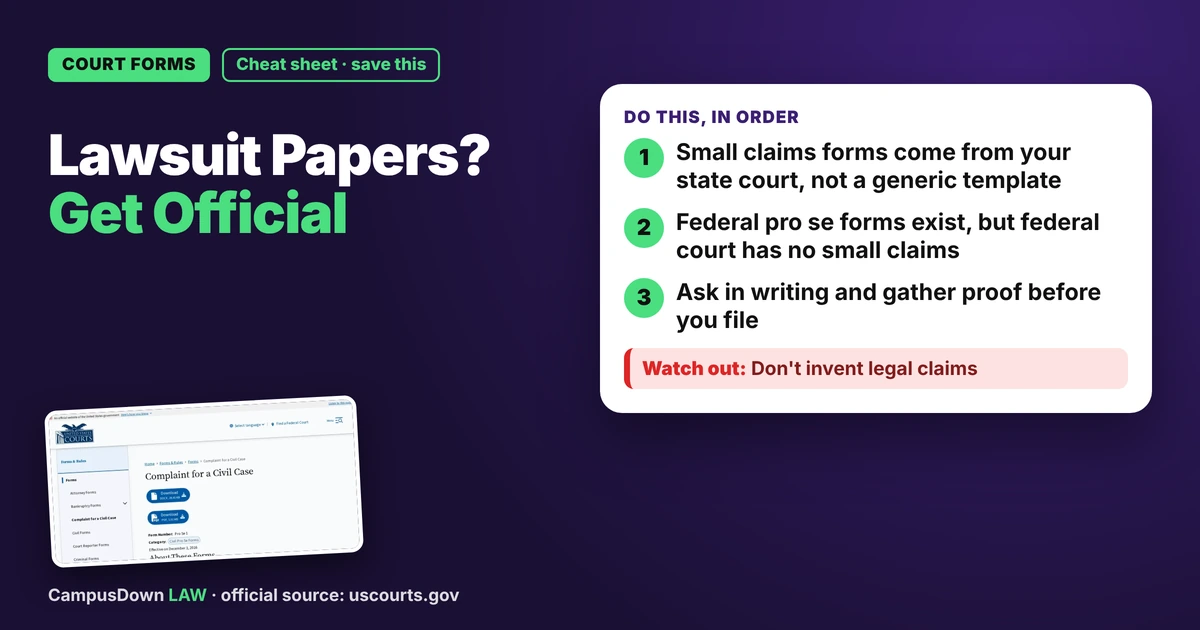
- Small claims forms come from your state court, not a generic template.
- Federal pro se forms exist, but federal court has no small claims.
- Ask in writing and gather proof before you file.
General information, not legal advice. Rules vary by state and can change; check the official sources linked in this guide.
Searching lawsuit papers template at 1 a.m. because someone owes you money and won't answer texts? Same energy. Here's the good news: for small claims, you usually don't need a random template from the internet. Courts publish their own official forms, often free to download.
Real talk: I'm a student, not a lawyer. This is general info, not legal advice, and every state runs small claims its own way.
First: small claims is a state court thing
Small claims courts are run by states (and sometimes counties or cities), so the forms come from your state court system, not the federal government. Each state sets its own dollar limits, filing fees and steps. The safest move is to start from your state court's official self-help pages, not a generic "lawsuit papers" download.
A few official state examples:
- California: Small Claims self-help from California Courts.
- Texas: TexasCourtHelp.gov, the state's court self-help site.
- Illinois: Illinois Supreme Court approved statewide forms.
For other states, search for your state's judicial branch website plus "small claims," and make sure the address ends in .gov or is clearly the official court site.
Federal court forms (when they apply)
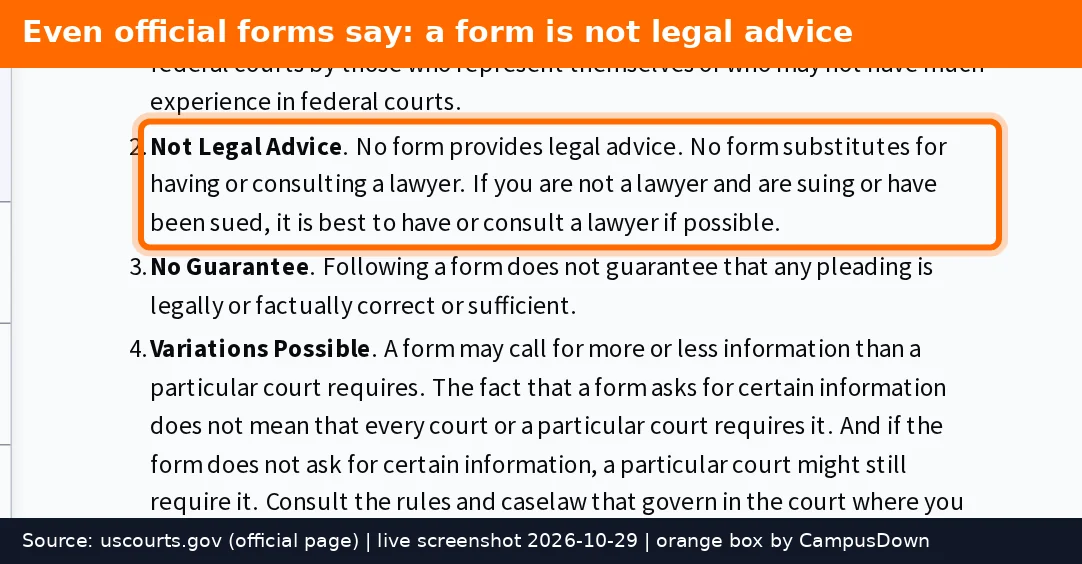
Federal courts don't have small claims. But they do post free official forms for people filing without a lawyer, called "pro se" forms, including a general complaint for a civil case. The U.S. Courts Pro Se 1 complaint page has it as a fill-in document. Most everyday money disputes with a roommate, landlord or store aren't federal cases, so check whether federal court even fits before you use it.
What the official forms usually ask for
Every state's form is different, but they tend to ask for similar basics:
- Your name and address, and the other side's correct legal name and address.
- How much you're asking for and how you got that number.
- A short description of what happened and when.
- Whether you asked for the money first. Some courts ask about this.
The name part trips people up more than you'd think. Suing "Mike from the apartment" won't work; courts need the right person or business, which is what identification of parties is about. For a business, its registered name can differ from the name on the sign.
Before you file
- Ask in writing first.* A demand letter or a consumer complaint letter shows you tried to settle it.
- Gather your proof* with the evidence checklist.
- Check deadlines* on your state court site or with legal aid.
That deadline point is real: claims can expire after a set time, the idea behind extinctive prescription, which US law usually calls a statute of limitations. And if the whole process feels like a black box, an overview of civil procedure steps helps it make sense.
Our guide on how to find official court forms goes deeper on spotting real court sites versus form-selling sites.
If you can't afford the filing fee
Many courts have a fee waiver process for people who can't pay. Look for it on the same official self-help page as the forms, or ask the court clerk. The complaint letters hub also links the letters you might send before filing.
Found this helpful? Share it with a friend who needs it.
Pick an app — it just sends the link, nothing else.
Frequently Asked Questions
Is there a free lawsuit papers template for small claims?
Usually the best "template" is your state court's official small claims form, which is often free to download from the court's website. Filing fees are separate.
Can I use federal court forms for small claims?
Federal courts don't have small claims. Small claims cases go through state courts, which have their own forms.
Where do I find my state's small claims forms?
Start at your state judicial branch's self-help site and search for small claims. Make sure it's the official court site.
Do I need a lawyer for small claims?
Many people handle small claims on their own, and some states limit lawyers in small claims. Check your state's rules, and contact legal aid if you're unsure.