Hidden Charges Complaint Letter Example
“Nearly re-enrolled in English class while reading a lease.”
- Best for
- Shoppers · Subscribers · Students with a surprise bill
- When to use
- When a checkout total or bill included fees you were not shown before you paid.
Download free
- Download PDF.pdf · 45 KB
- Download Word.docx · 37 KB
Not a court form. Not legal advice. A general worksheet to help you organize and write; check your court or a legal aid office before filing anything.
No sign-up or email needed. Free for personal and business use; please don't resell the file itself.
About this document
Paid more than the price you were shown? This free hidden charges complaint letter is a fill-in-the-blanks example you can send to a company about fees that showed up at checkout or on your bill without being disclosed first. Download it in Word or PDF below, or copy the text straight from this page.
I'm a student, not a lawyer. This is general information, not legal advice, and it's not a court form. Updated October 28, 2026.
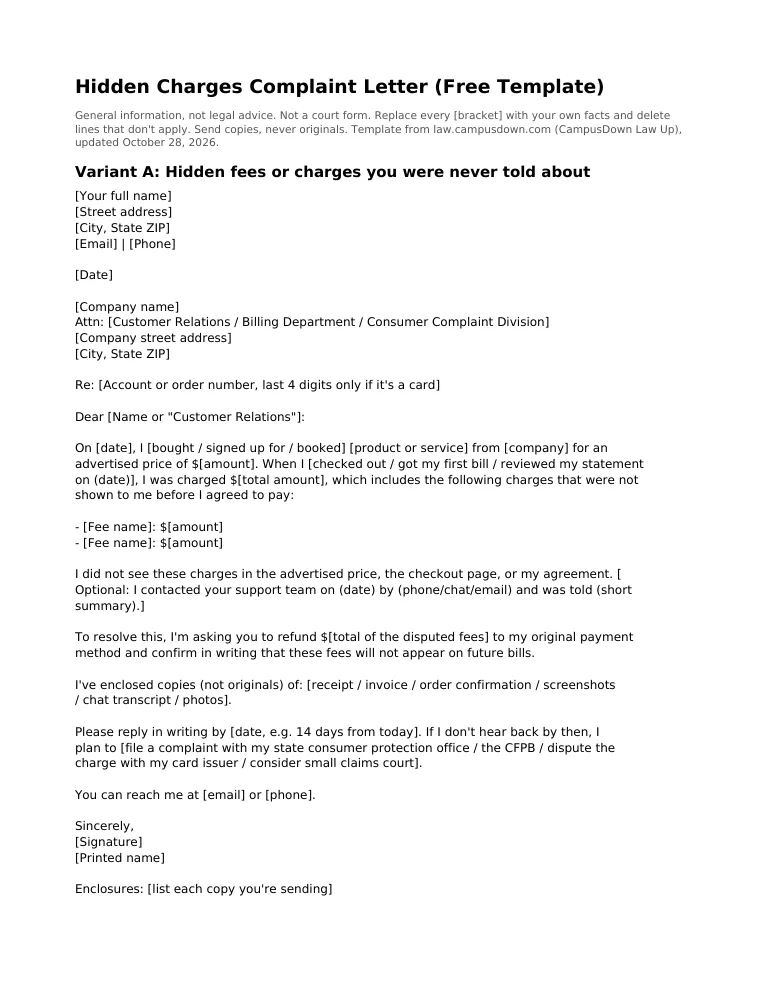
Hidden charges complaint letter example
Replace every [bracket], delete what doesn't apply, and keep a copy of what you send.
[Your full name]
[Street address]
[City, State ZIP]
[Email] | [Phone]

[Date]

[Company name]
Attn: [Customer Relations / Billing Department / Consumer Complaint Division]
[Company street address]
[City, State ZIP]

Re: [Account or order number, last 4 digits only if it's a card]

Dear [Name or "Customer Relations"]:

On [date], I [bought / signed up for / booked] [product or service] from [company] for an advertised price of $[amount]. When I [checked out / got my first bill / reviewed my statement on (date)], I was charged $[total amount], which includes the following charges that were not shown to me before I agreed to pay:

- [Fee name]: $[amount]
- [Fee name]: $[amount]

I did not see these charges in the advertised price, the checkout page, or my agreement. [Optional: I contacted your support team on (date) by (phone/chat/email) and was told (short summary).]

To resolve this, I'm asking you to refund $[total of the disputed fees] to my original payment method and confirm in writing that these fees will not appear on future bills.

I've enclosed copies (not originals) of: [receipt / invoice / order confirmation / screenshots / chat transcript / photos].

Please reply in writing by [date, e.g. 14 days from today]. If I don't hear back by then, I plan to [file a complaint with my state consumer protection office / the CFPB / dispute the charge with my card issuer / consider small claims court].

You can reach me at [email] or [phone].

Sincerely,
[Signature]
[Printed name]

Enclosures: [list each copy you're sending]
The fee worksheet (page 2 of the download)
Before you write, list each fee in a small table: the fee name exactly as it appears on your receipt, the amount, the date, and where (if anywhere) it was shown before you paid. That last column is the whole argument. "Service fee, $8.50, first shown on the final payment screen" is a lot harder to brush off than "there were extra fees."
- Screenshot the advertised price while the listing is still up. Pages and prices change.
- Save the checkout page or confirmation email that shows the final total.
- Grab the receipt or statement line with the posted amount.
- Note any chat or call with the date and the rep's name or ticket number.
What to ask for
Ask for one specific fix: a refund of the exact fee total to your original payment method, plus written confirmation the fee won't repeat. If it's a recurring bill, ask them to remove it from future bills too. Vague asks like "make this right" give them room to offer a coupon instead of your money back.
Why this matters, briefly: a big part of consumer protection law is about whether the price you were shown was the price you really paid. How sellers set and split prices is something economists study too (see price discrimination). You don't need any of that vocabulary in your letter. Your screenshots say it for you.
If you paid by credit card
Don't let a slow company reply run out your card dispute clock. The FTC's sample card dispute letter page says to send a dispute letter within 60 calendar days of when the first statement with the disputed charge was sent to you, to the issuer's billing-disputes address (not the payment address). You can write to the company and your card issuer at the same time.
If they ignore you
- Card, bank, loan or other financial product: CFPB complaint.
- Any business: your state consumer protection office.
- Deceptive ads or a scam: ReportFraud.ftc.gov (the FTC uses reports for cases; it generally doesn't resolve individual ones).
- Money still owed: small claims forms and where to find them.
More letters (double billing, broken products, escalation): consumer complaint letter templates and the complaint letters hub.
Know someone stuck with a landlord or billing problem? Pass this along.
Pick an app — it just sends the link, nothing else.
Frequently Asked Questions
How do I complain about hidden fees?
Write to the company with each fee listed by name and amount, where the price was shown before you paid, and the exact refund you want, with copies of screenshots and receipts. If you paid by credit card, consider a card dispute too, since the dispute window starts from your statement.
What if the fee was in the fine print?
Say what you saw and when, honestly. Whether a fee was disclosed well enough can depend on the rules for that industry and your state, so if the company refuses, your state consumer protection office is a good next step.
Is this a legal form?
No. It's a general letter template, not a court form and not legal advice.