A Guy Swung at Me at a Party. When Is It Actually Self-Defense?
Somebody threw a punch at a party and you hit back? A student's plain look at self-defense basics, why de-escalation matters, and what to do after.
“Nearly re-enrolled in English class while reading a lease.”
Theology · Scripture Cards
Open a scripture card
Already read and shared by 315 people.
 I Am with You Always
Matthew 28:20
teaching them to observe all things that I commanded you. Behold, I am with you always, even to the end of the age.” Amen.
Read this card
 Bread from Heaven
Exodus 16:4
Then Yahweh said to Moses, “Behold, I will rain bread from the sky for you, and the people shall go out and gather a day’s portion every…
Read this card
 Hosanna to the Son of David
Matthew 21:9
The multitudes who went in front of him, and those who followed, kept shouting, “Hosanna to the son of David! Blessed is he who comes in…
Read this card
 While He Was Still a Long Way Off
Luke 15:20, 22
“He arose and came to his father. But while he was still far off, his father saw him and was moved with compassion, and ran, fell on his…
Read this card
 Listen to Him
Matthew 17:5
While he was still speaking, behold, a bright cloud overshadowed them. Behold, a voice came out of the cloud, saying, “This is my beloved…
Read this card
 Today a Savior Is Born
Luke 2:10-11
The angel said to them, “Don’t be afraid, for behold, I bring you good news of great joy which will be to all the people. For there is born…
Read this card
 The God Who Brought You Out
Exodus 20:2
“I am Yahweh your God, who brought you out of the land of Egypt, out of the house of bondage.
Read this card
 The Lord Is My Shepherd
Psalm 23:1, 4
Yahweh is my shepherd; I shall lack nothing. … Even though I walk through the valley of the shadow of death, I will fear no evil, for you…
Read this card
Key Takeaways
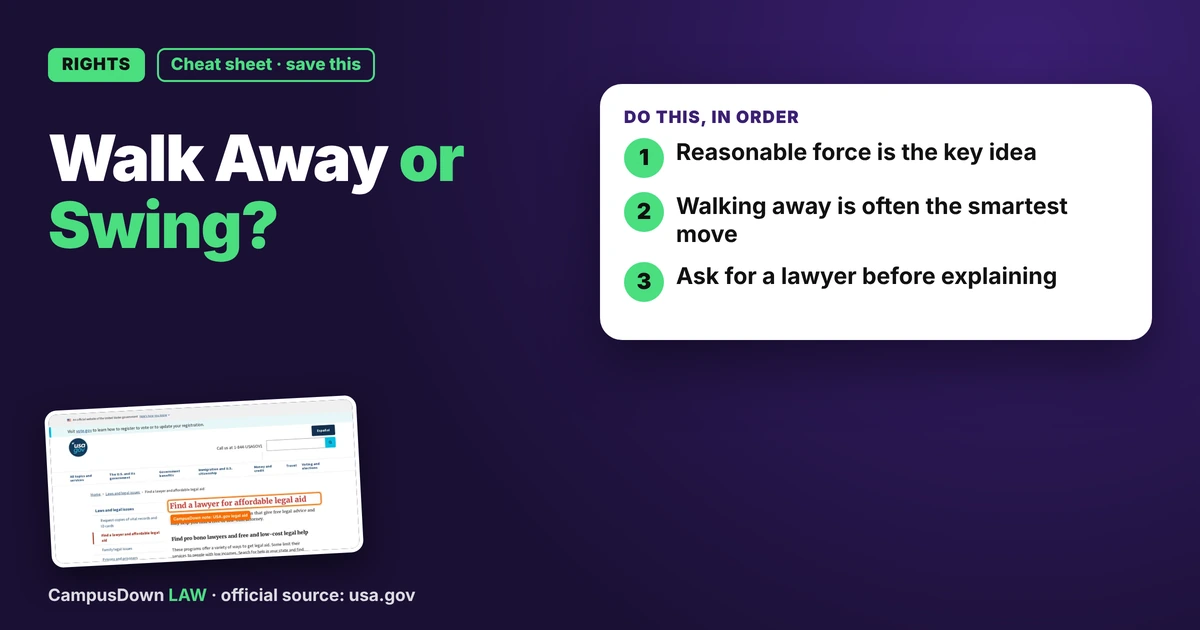
- Reasonable force is the key idea.
- Walking away is often the smartest move.
- Ask for a lawyer before explaining.
General information, not legal advice. Rules vary by state and can change; check the official sources linked in this guide.
Parties are 90% bad music and 10% that one guy who gets loud after three drinks. If that guy took a swing at you, and now you're replaying it at 3 a.m. and searching is it self defense if someone swings at me at a college party, let's go through the basics.
Real talk: I'm not a lawyer. Self-defense law is very state-specific and fact-specific. This is general info, not advice about your case.
The general idea
The wiki on self-defense law explains that many places allow reasonable force to protect yourself from an imminent threat. Words like "reasonable," "proportional," and "imminent" do a lot of work there. Shoving someone off you is different from chasing them down the block afterward.
Some states also have rules about whether you need to try to retreat first if you safely can. Those rules vary, so I'm not going to pretend there's one answer.
Why walking away is so underrated
Leaving the room is not losing. If you can safely get out, that's usually the move. Fights at parties can involve people you didn't even see, phones recording from weird angles, and very fuzzy memories later.
If police get involved
Keep your voice low and your hands where officers can see them. Lots of defense attorneys suggest one calm sentence: you'll answer questions once your lawyer is there. Why that matters is covered in the wiki on the right to silence. Adrenaline plus storytelling at 2 a.m. rarely ends well.
Charged and broke? Courts can appoint counsel in criminal cases, a rule the famous Gideon v. Wainwright decision made national. USA.gov's legal help finder can point you to free or low-cost options too.
The school angle
Colleges often treat fights seriously, even off campus. A conduct office might open a case separately from police. Read any email from them and respond on time. You can usually bring an advisor to meetings.
Things I'd avoid
- Posting about the fight online.
- Messaging the other person.
- Going back to "settle it."
- Deleting videos or messages; that can look bad.
Honestly, I'd rather leave a party early and get pizza with friends than end up in a police report. And if someone asks why I left, "I had better things to do" is true when the better thing is texting someone I actually like.
Know someone stuck with a landlord or billing problem? Pass this along.
Pick an app — it just sends the link, nothing else.
Frequently Asked Questions
Is hitting back always self-defense?
Not always. Many states allow reasonable force against an imminent threat. Details and state rules matter.
Do I have to walk away?
Some states have a duty to retreat if you safely can. Rules vary.
Should I talk to police about the fight?
You can ask to stay silent and talk to a lawyer first. That's often recommended.
Can my college discipline me for an off-campus fight?
Often yes. Check your code of conduct.