My Boss Offered a Raise. Will a Higher Tax Bracket Eat It?
Scared a raise means less take-home pay? A student's plain breakdown of tax brackets, marginal vs. effective rates, and where to check your own withholding.
“Nearly re-enrolled in English class while reading a lease.”
Theology · Scripture Cards
Open a scripture card
Already read and shared by 315 people.
 The Lord, He Is God
1 Kings 18:38-39
Then Yahweh’s fire fell and consumed the burnt offering, the wood, the stones, and the dust; and it licked up the water that was in the…
Read this card
 Daughter, Your Faith Has Healed You
Mark 5:34
He said to her, “Daughter, your faith has made you well. Go in peace, and be cured of your disease.”
Read this card
 Surely I Will Be with You
Judges 6:16
Yahweh said to him, “Surely I will be with you, and you shall strike the Midianites as one man.”
Read this card
 The Sun of Righteousness
Malachi 4:2
But to you who fear my name shall the sun of righteousness arise with healing in its wings. You will go out and leap like calves of the…
Read this card
 The Lord Is My Shepherd
Psalm 23:1, 4
Yahweh is my shepherd; I shall lack nothing. … Even though I walk through the valley of the shadow of death, I will fear no evil, for you…
Read this card
 Enter His Gates with Thanksgiving
Psalm 100:4-5
Enter into his gates with thanksgiving, and into his courts with praise. Give thanks to him, and bless his name. For Yahweh is good. His…
Read this card
 Peace, Be Still
Mark 4:39, 41
He awoke and rebuked the wind, and said to the sea, “Peace! Be still!” The wind ceased and there was a great calm. … They were greatly…
Read this card
 Let There Be Light
Genesis 1:3-4
God said, “Let there be light,” and there was light. God saw the light, and saw that it was good. God divided the light from the darkness.
Read this card
Key Takeaways
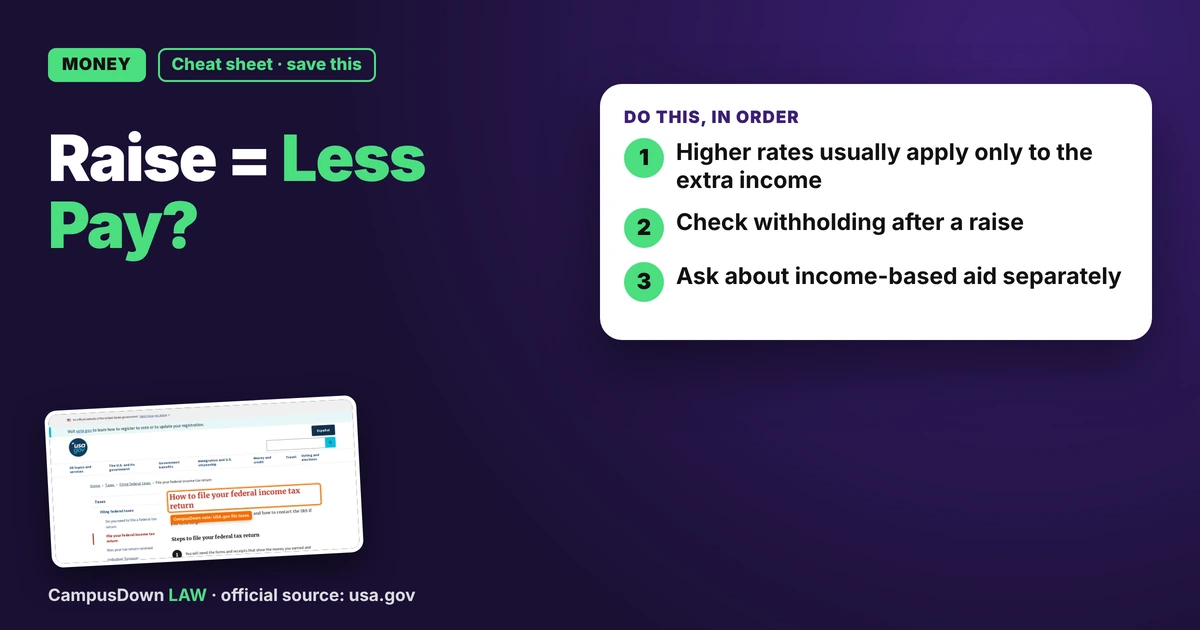
- Higher rates usually apply only to the extra income.
- Check withholding after a raise.
- Ask about income-based aid separately.
General information, not legal advice. Rules vary by state and can change; check the official sources linked in this guide.
My manager offered me a small raise and my coworker said, "Careful, bro, it'll push you into a higher bracket and you'll take home less." I almost turned it down. Then I went home and typed will a raise push me into a higher tax bracket and lower my take home like a person who did not pay attention in econ.
Small note first: not a tax pro, just a guy with a calculator app. Tax laws change and everyone's situation is different.
How brackets actually work
U.S. federal income tax uses brackets, but each rate generally applies only to the slice of income inside that bracket. The wiki on marginal and effective tax rates explains it well: your marginal rate is what you pay on the next dollar, while your effective rate is your total tax divided by total income.
So crossing into a new bracket usually means only the dollars above the line get the higher rate, not all your income.
Why it can still feel weird
Some things can make a raise feel smaller than expected:
- Payroll taxes and state taxes take a slice too.
- Your withholding might change.
- Some benefits or aid based on income may shift.
Those last ones are the real "cliff" stuff people talk about, and they depend on the program. It's worth asking your financial aid office if income affects your aid. Economists also talk about who really carries a tax burden; the wiki on tax incidence is a fun rabbit hole on that.
Where to read the official stuff
USA.gov's hub on filing your taxes links to IRS tools, free filing options, and help pages. That's where I'd look for current-year numbers instead of trusting a coworker or a meme.
The inflation angle
Raises also matter because prices keep going up. The wiki on inflation explains why a raise can feel like it just keeps you even. That's another reason not to wave one off.
My plan now
Take the raise, check my withholding, keep an eye on any aid that's income-based, and maybe put a few extra bucks toward an actual date night instead of pretending a gas station coffee counts as one.
Know someone stuck with a landlord or billing problem? Pass this along.
Pick an app — it just sends the link, nothing else.
Frequently Asked Questions
Will a raise lower my take-home pay because of brackets?
Usually not under federal brackets, since higher rates apply only to the income above each threshold. Other programs can have income limits.
What's the difference between marginal and effective tax rate?
Marginal is the rate on your next dollar. Effective is total tax divided by total income.
Should I update my W-4 after a raise?
It can help. The IRS withholding estimator is a good check.
Can a raise affect financial aid?
Sometimes. Ask your financial aid office.