I Clicked a Link in a Phishing Text. What Should I Do Now?
Clicked a link in a phishing text? Learn the first steps to protect your accounts, what to do if you entered info, and where to report scam texts.
“Nearly re-enrolled in English class while reading a lease.”
Theology · Scripture Cards
Open a scripture card
Already read and shared by 315 people.
 Peace, Be Still
Mark 4:39, 41
He awoke and rebuked the wind, and said to the sea, “Peace! Be still!” The wind ceased and there was a great calm. … They were greatly…
Read this card
 I Know That My Redeemer Lives
Job 19:25
But as for me, I know that my Redeemer lives. In the end, he will stand upon the earth.
Read this card
 Water from the Rock
Exodus 17:6
Behold, I will stand before you there on the rock in Horeb. You shall strike the rock, and water will come out of it, that the people may…
Read this card
 God Shut the Lions’ Mouths
Daniel 6:22
My God has sent his angel, and has shut the lions’ mouths, and they have not hurt me, because innocence was found in me before him; and…
Read this card
 Your God, My God
Ruth 1:16
Ruth said, “Don’t urge me to leave you, and to return from following you, for where you go, I will go; and where you stay, I will stay.…
Read this card
 The Jar Was Not Empty
1 Kings 17:14, 16
For Yahweh, the God of Israel, says, ‘The jar of meal will not run out, and the jar of oil will not fail, until the day that Yahweh sends…
Read this card
 While He Was Still a Long Way Off
Luke 15:20, 22
“He arose and came to his father. But while he was still far off, his father saw him and was moved with compassion, and ran, fell on his…
Read this card
 The Sun of Righteousness
Malachi 4:2
But to you who fear my name shall the sun of righteousness arise with healing in its wings. You will go out and leap like calves of the…
Read this card
Key Takeaways
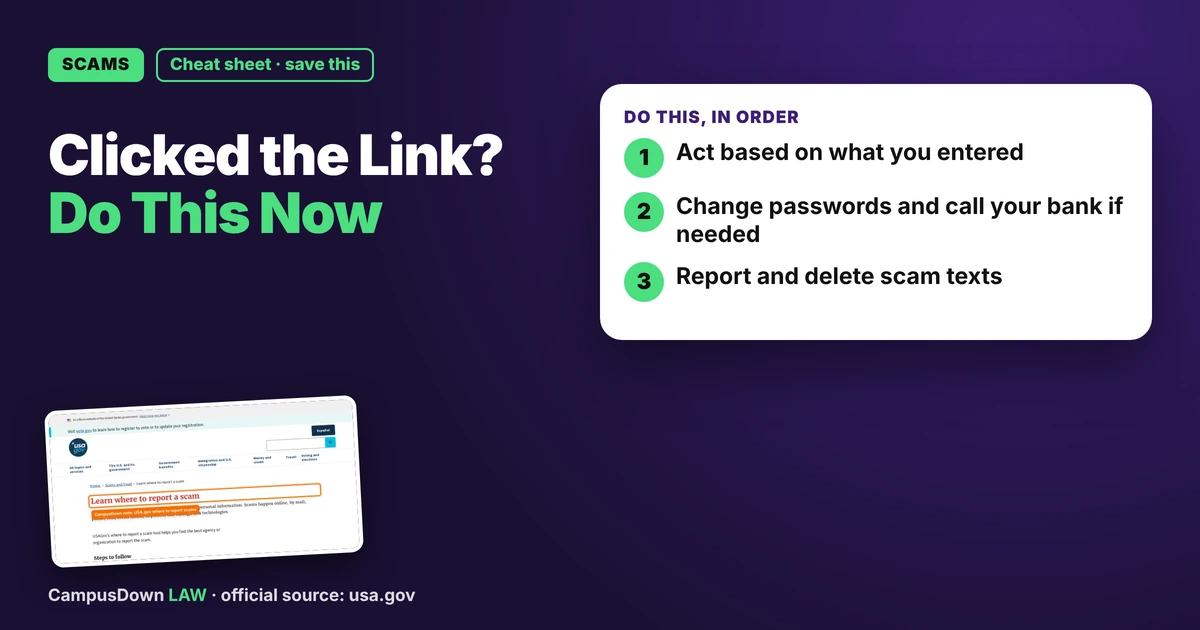
- Act based on what you entered.
- Change passwords and call your bank if needed.
- Report and delete scam texts.
General information, not legal advice. Rules vary by state and can change; check the official sources linked in this guide.
"Your package couldn't be delivered, update your address here." I was literally waiting for a package. I clicked. Then my brain caught up. If you're searching clicked a link in a phishing text what should I do, here's the checklist.
Not a lawyer or security pro. General info.
Did you just click, or enter info?
- Just clicked and closed it:* Close the page, don't download anything, and keep an eye on your accounts. Update your phone's software.
- Entered a password:* Change that password right away, plus anywhere you reused it. Turn on two-factor authentication.
- Entered card or bank info:* Call your bank or card issuer now and ask about blocking the card and watching for charges.
- Entered your SSN:* Consider a credit freeze and follow identity theft steps.
Report it
USA.gov's where to report scams page explains which agency handles which kind of scam. You can also forward scam texts to 7726 (SPAM) on many carriers, then delete them.
How phishing texts work
They copy real companies, create urgency ("your account will be locked!") and push you to act fast. They often use package delivery, bank alerts, toll road fees or job offers. It's psychological, not just technical.
Brain stuff
Urgency triggers loss aversion: fear of losing access makes you click. Confirmation bias helps if you were expecting a package. And optimism bias says "I'd never fall for that." Anyone can.
Prevent the next one
Go to the company's app or website yourself instead of clicking links. Use a password manager. Turn on two-factor authentication. Learn your right to privacy basics: your login codes are yours, never share them.
Legal stuff is easier with a friend. Send this to someone who could use it.
Pick an app — it just sends the link, nothing else.
Frequently Asked Questions
What happens if I just clicked a phishing link?
Often nothing if you didn't enter info or download anything, but close it, update your phone and watch accounts. Not legal advice.
What should I do if I entered my password?
Change it immediately, change it anywhere you reused it and turn on two-factor authentication.
How do I report a scam text?
Forward it to 7726 on many carriers and see USA.gov for where to report.
Should I reply STOP to a scam text?
It's generally better not to reply to scam texts.