They Called Me a "Contractor" at My Part-Time Gig. Is That Even Right?
Got a 1099 for a job that felt like a regular shift? A student's plain guide to contractor vs. employee, why it matters for pay, and where to ask questions.
“Nearly re-enrolled in English class while reading a lease.”
Theology · Scripture Cards
Open a scripture card
Already read and shared by 315 people.
 Let There Be Light
Genesis 1:3-4
God said, “Let there be light,” and there was light. God saw the light, and saw that it was good. God divided the light from the darkness.
Read this card
 Listen to Him
Matthew 17:5
While he was still speaking, behold, a bright cloud overshadowed them. Behold, a voice came out of the cloud, saying, “This is my beloved…
Read this card
 Be Strong and Courageous
Joshua 1:9
Haven’t I commanded you? Be strong and courageous. Don’t be afraid. Don’t be dismayed, for Yahweh your God is with you wherever you go.”
Read this card
 I Will Put Breath in You
Ezekiel 37:5-6
The Lord Yahweh says to these bones: “Behold, I will cause breath to enter into you, and you will live. I will lay sinews on you, and will…
Read this card
 Unto Us a Child Is Born
Isaiah 9:6
For a child is born to us. A son is given to us; and the government will be on his shoulders. His name will be called Wonderful Counselor…
Read this card
 My Heart Rejoices in the Lord
1 Samuel 2:1-2
Hannah prayed, and said, “My heart exults in Yahweh! My horn is exalted in Yahweh. My mouth is enlarged over my enemies, because I rejoice…
Read this card
 He Revealed His Glory
John 2:11
This beginning of his signs Jesus did in Cana of Galilee, and revealed his glory; and his disciples believed in him.
Read this card
 Look and Live
Numbers 21:8-9
Yahweh said to Moses, “Make a venomous snake, and set it on a pole. It shall happen that everyone who is bitten, when he sees it, shall…
Read this card
Key Takeaways
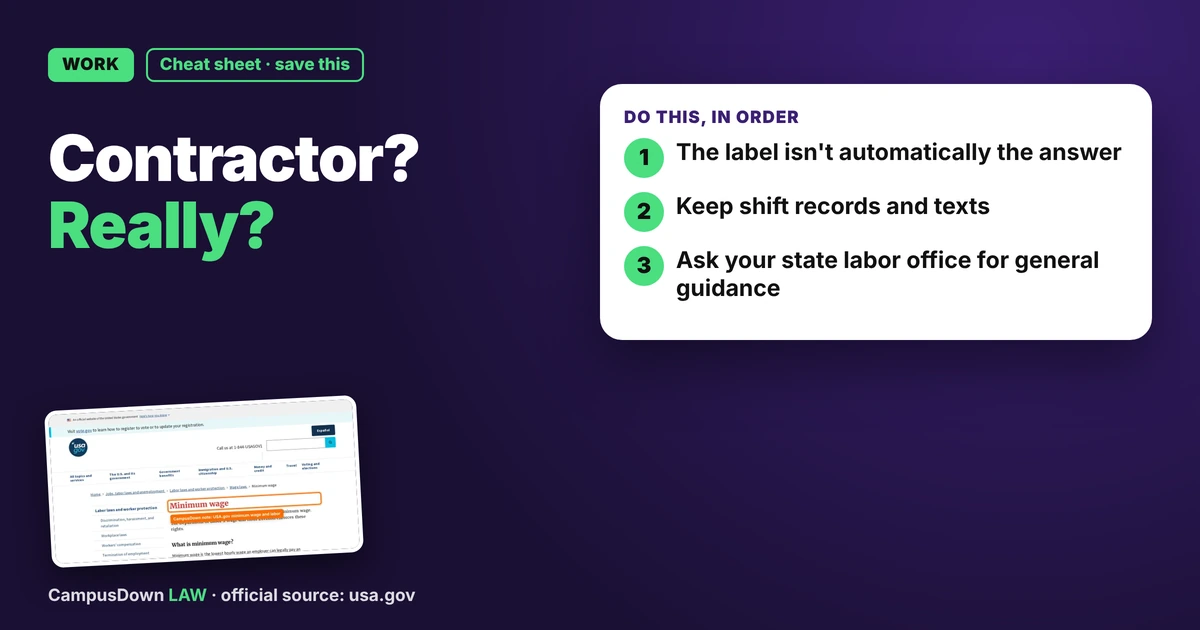
- The label isn't automatically the answer.
- Keep shift records and texts.
- Ask your state labor office for general guidance.
General information, not legal advice. Rules vary by state and can change; check the official sources linked in this guide.
The job: set schedule, a manager texting me where to stand, a branded polo I had to wear. The paperwork: "independent contractor agreement." If that combo made you search misclassified as independent contractor at my student job what now, pull up a chair. I've got snacks (crackers, half a sleeve).
Small print from me: I'm a student, not an employment lawyer, and what follows is general information. Labor rules differ between federal law and each state.
Why the label matters at all
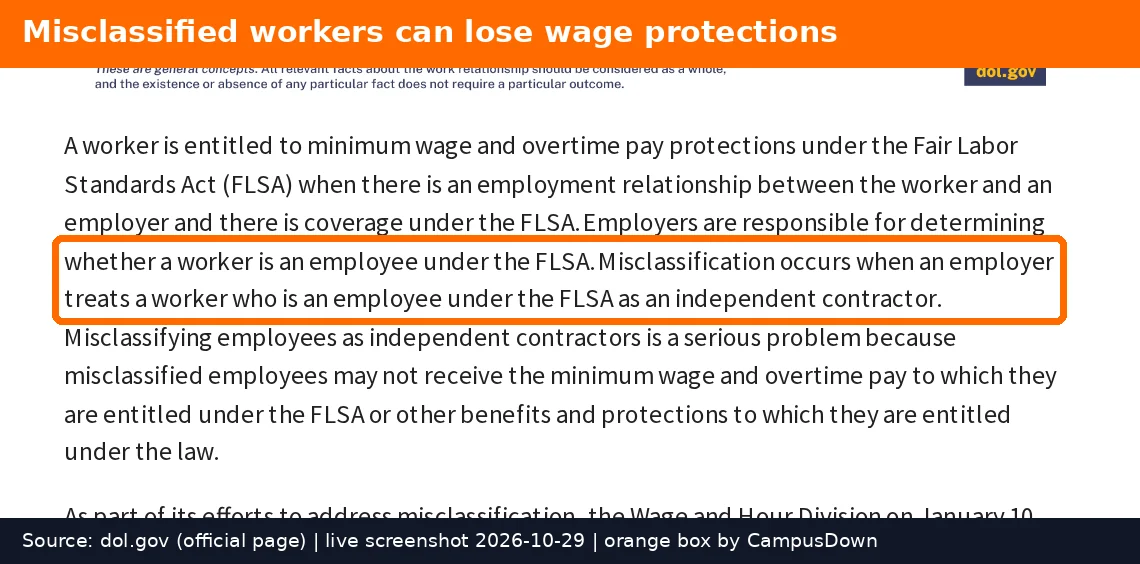
The difference between employee and contractor isn't just a word on a form. It can affect minimum wage, overtime, who pays certain taxes, and whether you get protections like unemployment insurance. The wiki article on independent contractor vs. employee lays out the general factors people look at, like how much control the company has over how you do the work.
What stuck with me: the label in the contract isn't automatically the final answer. Agencies and courts often look at how the job actually works day to day.
Signs that made me squint
These aren't legal tests, just things that felt off in my case:
- A fixed schedule set by a manager.
- Training on exactly how to do every task.
- Uniform and tools provided by the company.
- No real way to work for competitors or set my own price.
- Doing the core thing the business sells.
Real contractors usually have more say over the how, when, and price. If none of that sounds like your gig, it might be worth asking questions.
Pay rules you should know exist
Employees are generally covered by minimum wage and overtime rules, while true contractors often aren't. That's a big deal if you're working long shifts at a flat rate. USA.gov keeps a page on minimum wage and labor questions that points to federal and state contacts.
On the tax side, contractors usually handle their own taxes, which can be a surprise bill in April. That's often the moment students realize something's weird.
Ways to raise it without blowing up your job
Retaliation worries are real. Some quieter options:
- Ask HR or your manager, in writing, how they decided on contractor status.
- Talk to your campus career center or student legal services.
- Contact your state labor department for general info.
- Reach out to a legal aid office if you think you're owed wages.
The broader shift toward the gig economy has made this question super common, so you won't be the first person they've heard it from.
The money math feels personal
When you're on a ramen budget, a few missing hours of overtime or surprise taxes can wreck a month. I'm not saying every contractor label is wrong. Some gigs genuinely are freelance. But you're allowed to ask, and asking is not the same as suing anybody.
And hey, if you end up with a cleaner paycheck, maybe that's a nicer second-date dinner. Just a thought.
Found this helpful? Share it with a friend who needs it.
Pick an app — it just sends the link, nothing else.
Frequently Asked Questions
Can my employer just call me a contractor?
They can use the label, but agencies and courts generally look at how the work actually happens. Rules vary.
What's the downside of being misclassified?
You might miss out on minimum wage, overtime, and certain tax or benefit protections.
Who do I contact about misclassification?
Your state labor department, the federal wage office, or a legal aid group are common places to start.
Will I get in trouble for asking?
Many laws protect workers from retaliation, but details vary. Keep records and get advice.