I Wrote a True Review and Now the Business Says I Defamed Them
A business claims your honest online review is defamation? A student's plain guide to truth as a defense, opinion versus fact, and what to do next.
“Nearly re-enrolled in English class while reading a lease.”
Theology · Scripture Cards
Open a scripture card
Already read and shared by 315 people.
 This Is My Beloved Son
Matthew 3:16-17
Jesus, when he was baptized, went up directly from the water: and behold, the heavens were opened to him. He saw the Spirit of God…
Read this card
 I Will Put Breath in You
Ezekiel 37:5-6
The Lord Yahweh says to these bones: “Behold, I will cause breath to enter into you, and you will live. I will lay sinews on you, and will…
Read this card
 For Such a Time as This
Esther 4:14
For if you remain silent now, then relief and deliverance will come to the Jews from another place, but you and your father’s house will…
Read this card
 I Am the Resurrection and the Life
John 11:25-26
Jesus said to her, “I am the resurrection and the life. He who believes in me will still live, even if he dies. Whoever lives and believes…
Read this card
 The Sun of Righteousness
Malachi 4:2
But to you who fear my name shall the sun of righteousness arise with healing in its wings. You will go out and leap like calves of the…
Read this card
 Today a Savior Is Born
Luke 2:10-11
The angel said to them, “Don’t be afraid, for behold, I bring you good news of great joy which will be to all the people. For there is born…
Read this card
 God So Loved the World
John 3:16
For God so loved the world, that he gave his only born Son, that whoever believes in him should not perish, but have eternal life.
Read this card
 Surely I Will Be with You
Judges 6:16
Yahweh said to him, “Surely I will be with you, and you shall strike the Midianites as one man.”
Read this card
Key Takeaways
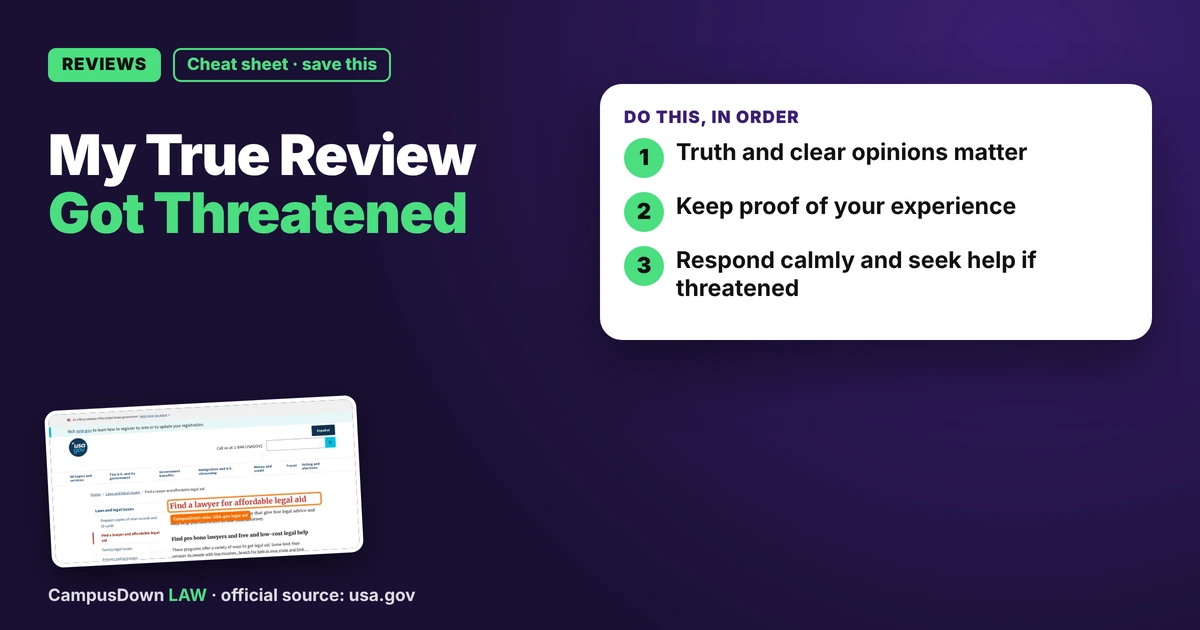
- Truth and clear opinions matter.
- Keep proof of your experience.
- Respond calmly and seek help if threatened.
General information, not legal advice. Rules vary by state and can change; check the official sources linked in this guide.
I took a date to a small restaurant near campus, ordered the "house special," and found a hair in it. The staff shrugged. I went home and wrote a calm, detailed review. Two days later, the owner messaged me saying my review was "defamatory" and I should take it down or else. If you're dealing with something similar and searching business says my honest review is defamation but it's true, here's how I'm thinking about it.
Quick reality check: I'm a student who reads too much, not a media lawyer. Defamation rules vary by state, and specific facts matter a lot.
What defamation generally means
Broadly, defamation is about false statements of fact that harm someone's reputation. The wiki on freedom of expression and defamation explains the balance between free speech and protecting reputations.
The key word: false. If what you said is true, that's a big deal. The wiki on the truth defense in defamation explains how truth is often a defense to defamation claims.
Facts versus opinions
Opinions like "the pasta was bland" or "worst date night ever" are usually treated differently from fact claims like "they use expired meat." Clear opinions and true facts are generally safer than accusations you can't prove.
Look at your review and ask:
- Did I describe what happened, honestly?
- Did I use opinion language for my feelings?
- Did I avoid claims I can't back up?
Respond calmly
Don't fire back an angry reply. You can calmly say you stand by your honest experience, or you can choose to edit language to make opinions clearer. Deleting or keeping the review is your decision. Some people choose to edit to avoid stress, and that's okay too.
If you get a formal letter from a lawyer, don't ignore it. Read it carefully and consider getting advice. Many letters are meant to scare, but you still want to respond wisely.
Get help if it escalates
If someone threatens a lawsuit, campus legal services or a local legal aid group may help. USA.gov's legal aid page points to free and low-cost options. Some states have laws to stop lawsuits meant to silence speech, often called anti-SLAPP laws, but they vary.
Review tips for the future
- Stick to what happened.
- Use "I felt" or "in my opinion" for feelings.
- Avoid guessing about motives or crimes.
- Keep receipts and photos.
The First Amendment and free speech protects a lot of speech, but it isn't a free pass to say false things. Honesty is the move.
Next time, I'm picking a restaurant with better reviews and hoping the date ends in dessert, not drama.
Found this helpful? Share it with a friend who needs it.
Pick an app — it just sends the link, nothing else.
Frequently Asked Questions
Can a true review be defamation?
Truth is often a defense to defamation claims. Facts matter.
What about opinions?
Clear opinions are usually treated differently from false factual claims.
Should I delete my review?
It's your choice. Consider editing to make opinions clear if you want to avoid conflict.
What if I get a legal letter?
Don't ignore it. Read carefully and seek advice.