My Internet Company Emailed Me About Copyright and I'm Sweating
Your internet provider forwarded a copyright infringement notice about a download? A student's plain guide to what it means, scam checks, and next steps.
“Nearly re-enrolled in English class while reading a lease.”
Theology · Scripture Cards
Open a scripture card
Already read and shared by 315 people.
 Unto Us a Child Is Born
Isaiah 9:6
For a child is born to us. A son is given to us; and the government will be on his shoulders. His name will be called Wonderful Counselor…
Read this card
 Your God, My God
Ruth 1:16
Ruth said, “Don’t urge me to leave you, and to return from following you, for where you go, I will go; and where you stay, I will stay.…
Read this card
 He Revealed His Glory
John 2:11
This beginning of his signs Jesus did in Cana of Galilee, and revealed his glory; and his disciples believed in him.
Read this card
 Daughter, Your Faith Has Healed You
Mark 5:34
He said to her, “Daughter, your faith has made you well. Go in peace, and be cured of your disease.”
Read this card
 While He Was Still a Long Way Off
Luke 15:20, 22
“He arose and came to his father. But while he was still far off, his father saw him and was moved with compassion, and ran, fell on his…
Read this card
 Not My Will, but Yours
Luke 22:42
saying, “Father, if you are willing, remove this cup from me. Nevertheless, not my will, but yours, be done.”
Read this card
 I Know That My Redeemer Lives
Job 19:25
But as for me, I know that my Redeemer lives. In the end, he will stand upon the earth.
Read this card
 I Am with You
Genesis 28:15
Behold, I am with you, and will keep you, wherever you go, and will bring you again into this land. For I will not leave you until I have…
Read this card
Key Takeaways
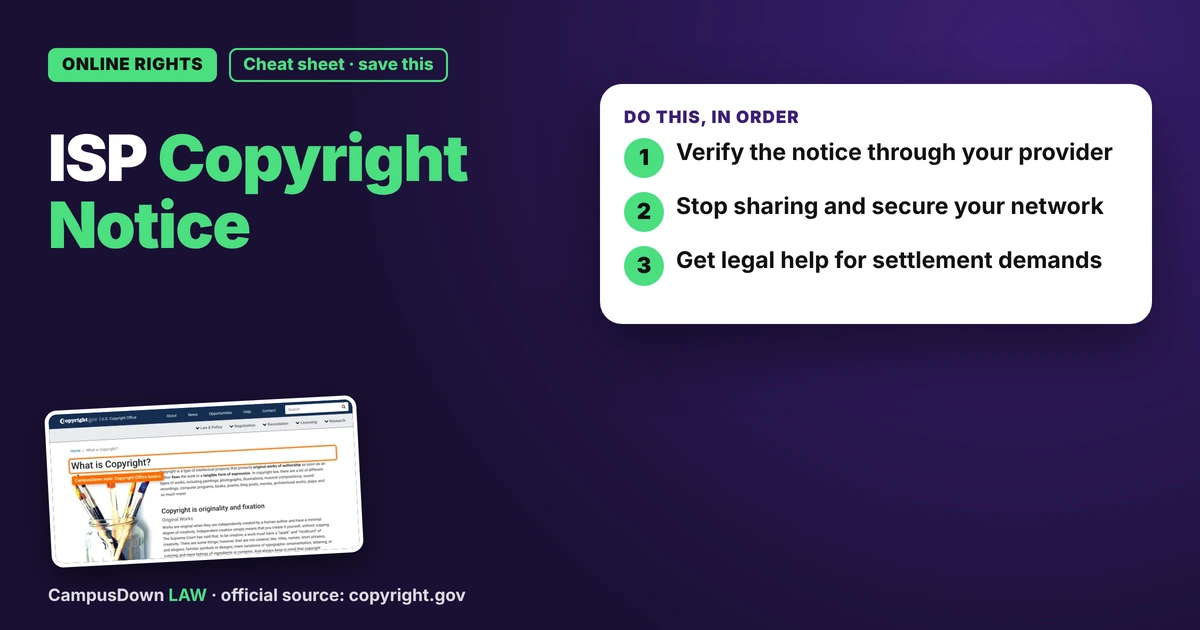
- Verify the notice through your provider.
- Stop sharing and secure your network.
- Get legal help for settlement demands.
General information, not legal advice. Rules vary by state and can change; check the official sources linked in this guide.
An email from my internet provider landed with the subject line "Notice of Claimed Infringement." My heart dropped into my sneakers. It mentioned a movie title, a date, and my IP address. I live alone, so I can't blame a roommate. (Well, I could blame the neighbor I almost shared Wi-Fi with, but I didn't.) So I searched my internet provider sent me a copyright infringement notice.
Disclaimer: I'm a student, not a copyright lawyer. This is general info about how these notices tend to work, not advice for your exact case.
What these notices usually are
Copyright holders sometimes monitor file-sharing networks and send notices to internet providers, who then forward them to the account holder. Often the notice is a warning, not a lawsuit. It may say what was allegedly shared and ask you to stop. The Copyright Office's "What is copyright" page explains the basics of what copyright protects. The wiki on copyright basics gives more background.
First, check it's real
Scammers copy these emails. Red flags:
- It demands immediate payment through a link or gift cards.
- It's not from your provider's real domain.
- It threatens jail if you don't pay in an hour.
Log into your provider account directly (not through the email link) or call the number on your bill to confirm.
If it's legit
- Stop any file sharing on your devices. Uninstall torrent clients you don't use.
- Change your Wi-Fi password and check for unknown devices.
- Save the notice and any replies.
- Read your provider's policy. Some providers have repeat-notice policies that could affect service.
Don't reply admitting anything or arguing details in a panic. If the notice mentions a settlement demand or lawsuit, that's when talking to a lawyer or legal aid matters. The idea of fair use gets thrown around online, but it rarely covers downloading full movies.
Why we think "it's fine"
The optimism bias makes people think they'll never be the one who gets flagged. And the free rider problem explains why "everyone does it" feels like a defense. It isn't.
My new streaming plan
- Use legal free options like library streaming apps.
- Share one subscription with friends where the terms allow.
- Wait for movies to hit free services.
Movie night with a date doesn't need pirated stuff. A cheap legal stream and microwave popcorn works fine.
Know someone stuck with a landlord or billing problem? Pass this along.
Pick an app — it just sends the link, nothing else.
Frequently Asked Questions
What is an ISP copyright notice?
Usually a forwarded warning from a copyright holder about alleged sharing.
Is it a lawsuit?
Often not. But settlement demands or court papers are more serious.
How do I tell if it's a scam?
Verify with your provider directly and avoid payment links.
What should I do next?
Stop sharing, secure Wi-Fi, save the notice, and get legal help if needed.