Asking for Disability Accommodations in College for the First Time
ADHD, anxiety, a chronic condition, or an injury? A student's plain guide to asking your college for accommodations, what to bring, and where to turn if denied.
“Nearly re-enrolled in English class while reading a lease.”
Theology · Scripture Cards
Open a scripture card
Already read and shared by 315 people.
 While He Was Still a Long Way Off
Luke 15:20, 22
“He arose and came to his father. But while he was still far off, his father saw him and was moved with compassion, and ran, fell on his…
Read this card
 The Lord Will Provide
Genesis 22:14
Abraham called the name of that place “Yahweh Will Provide”. As it is said to this day, “On Yahweh’s mountain, it will be provided.”
Read this card
 Twelve Baskets Left Over
John 6:11, 13
Jesus took the loaves, and having given thanks, he distributed to the disciples, and the disciples to those who were sitting down, likewise…
Read this card
 The Lord, He Is God
1 Kings 18:38-39
Then Yahweh’s fire fell and consumed the burnt offering, the wood, the stones, and the dust; and it licked up the water that was in the…
Read this card
 Enter His Gates with Thanksgiving
Psalm 100:4-5
Enter into his gates with thanksgiving, and into his courts with praise. Give thanks to him, and bless his name. For Yahweh is good. His…
Read this card
 He Is Not Here, He Has Risen
Matthew 28:5-6
The angel answered the women, “Don’t be afraid, for I know that you seek Jesus, who has been crucified. He is not here, for he has risen…
Read this card
 Your Faith Has Made You Well
Mark 10:52
Jesus said to him, “Go your way. Your faith has made you well.” Immediately he received his sight and followed Jesus on the way.
Read this card
 The Lord Will Fight for You
Exodus 14:13-14
Moses said to the people, “Don’t be afraid. Stand still, and see the salvation of Yahweh, which he will work for you today; for you will…
Read this card
Key Takeaways
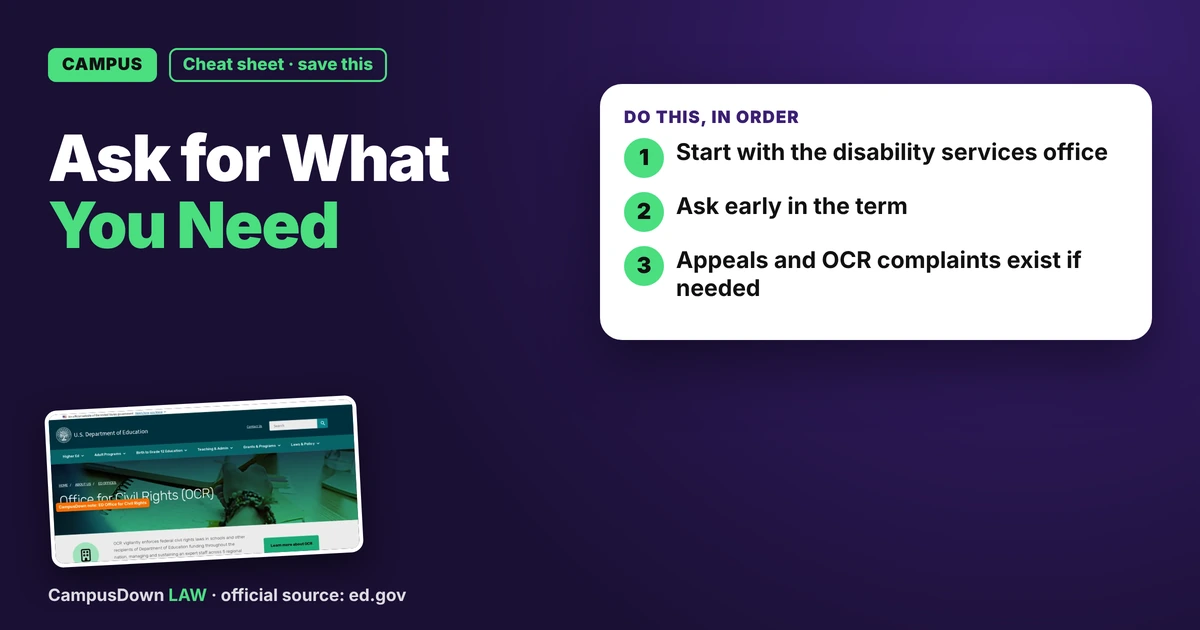
- Start with the disability services office.
- Ask early in the term.
- Appeals and OCR complaints exist if needed.
General information, not legal advice. Rules vary by state and can change; check the official sources linked in this guide.
In high school, my mom handled the meetings. In college, nobody hands you anything. If you've been staring at your disability office's website and typing how to ask for disability accommodations in college first time, I get it. That first email feels weirdly heavy.
Standard disclaimer in my own words: I'm a student sharing what I've read, not a lawyer. Each school runs its own process, and the law can apply differently depending on the facts.
The laws behind it, in plain English
Two big federal laws come up a lot. The Americans with Disabilities Act wiki page gives a good overview of how it bans disability discrimination in many settings, schools included. Section 504 of the Rehabilitation Act is the other one people mention for schools that get federal money. You don't need to memorize either. Just know accommodations aren't a favor; they're tied to civil rights.
Step one: find the right office
Most colleges have a disability services or accessibility office. That's who you talk to, not your professor first. Usually the flow looks like this:
- Fill out an intake form online.
- Share documentation, like a letter from a doctor or a past evaluation.
- Meet with a coordinator to talk about how the condition affects class.
- Get an accommodation letter to send to professors.
Common examples include extended test time, a quieter testing room, note-taking help, or flexibility on attendance for flare-ups. What you get depends on your situation.
What to say if you're nervous
I'd keep it simple: "I have a condition that affects how I take tests and focus in long lectures. I'd like to learn about accommodations." You don't have to tell your whole life story. The coordinator's job is to walk you through the rest.
If things go sideways
Sometimes a request gets denied or a professor ignores the letter. Most schools have an internal grievance or appeal process, so ask disability services about that first. If you think the school is discriminating, the Department of Education's Office for Civil Rights takes complaints, and its site explains who it covers. Complaint deadlines can be strict, so don't sit on it for months.
The idea of due process, getting a fair process before decisions that affect you, is useful to keep in mind when you ask how an appeal works.
It's not "special treatment"
The Civil Rights Act of 1964 set the stage for a lot of later anti-discrimination law, and disability rights built on that history. Accommodations level the playing field; they don't tilt it. Using them is a smart move, not a weakness.
And honestly, managing your health well leaves more energy for the good stuff, like a coffee date that doesn't get canceled because you're drowning in a missed exam.
Legal stuff is easier with a friend. Send this to someone who could use it.
Pick an app — it just sends the link, nothing else.
Frequently Asked Questions
Do I have to tell my professors my diagnosis?
Usually no. Many schools give a letter listing accommodations without the diagnosis. Ask your disability office.
What documents do I need?
It varies by school. A provider's letter or past evaluation is common.
What if my request is denied?
Ask about the school's appeal process. You can also look into a complaint with the Office for Civil Rights.
Can I ask for accommodations mid-semester?
Often yes, but earlier is better because approval takes time.