Can My Parents See My College Grades? What FERPA Actually Says
Can my parents see my college grades? Under FERPA, rights usually shift to you in college, but there are exceptions. Here's how it works and what to do.
“Nearly re-enrolled in English class while reading a lease.”
Theology · Scripture Cards
Open a scripture card
Already read and shared by 315 people.
 Listen to Him
Matthew 17:5
While he was still speaking, behold, a bright cloud overshadowed them. Behold, a voice came out of the cloud, saying, “This is my beloved…
Read this card
 The Lord Will Fight for You
Exodus 14:13-14
Moses said to the people, “Don’t be afraid. Stand still, and see the salvation of Yahweh, which he will work for you today; for you will…
Read this card
 Your God, My God
Ruth 1:16
Ruth said, “Don’t urge me to leave you, and to return from following you, for where you go, I will go; and where you stay, I will stay.…
Read this card
 Be Strong and Courageous
Joshua 1:9
Haven’t I commanded you? Be strong and courageous. Don’t be afraid. Don’t be dismayed, for Yahweh your God is with you wherever you go.”
Read this card
 I Am the Light of the World
John 8:12
Again, therefore, Jesus spoke to them, saying, “I am the light of the world. He who follows me will not walk in the darkness, but will have…
Read this card
 I Am the Resurrection and the Life
John 11:25-26
Jesus said to her, “I am the resurrection and the life. He who believes in me will still live, even if he dies. Whoever lives and believes…
Read this card
 For Such a Time as This
Esther 4:14
For if you remain silent now, then relief and deliverance will come to the Jews from another place, but you and your father’s house will…
Read this card
 Daughter, Your Faith Has Healed You
Mark 5:34
He said to her, “Daughter, your faith has made you well. Go in peace, and be cured of your disease.”
Read this card
Key Takeaways
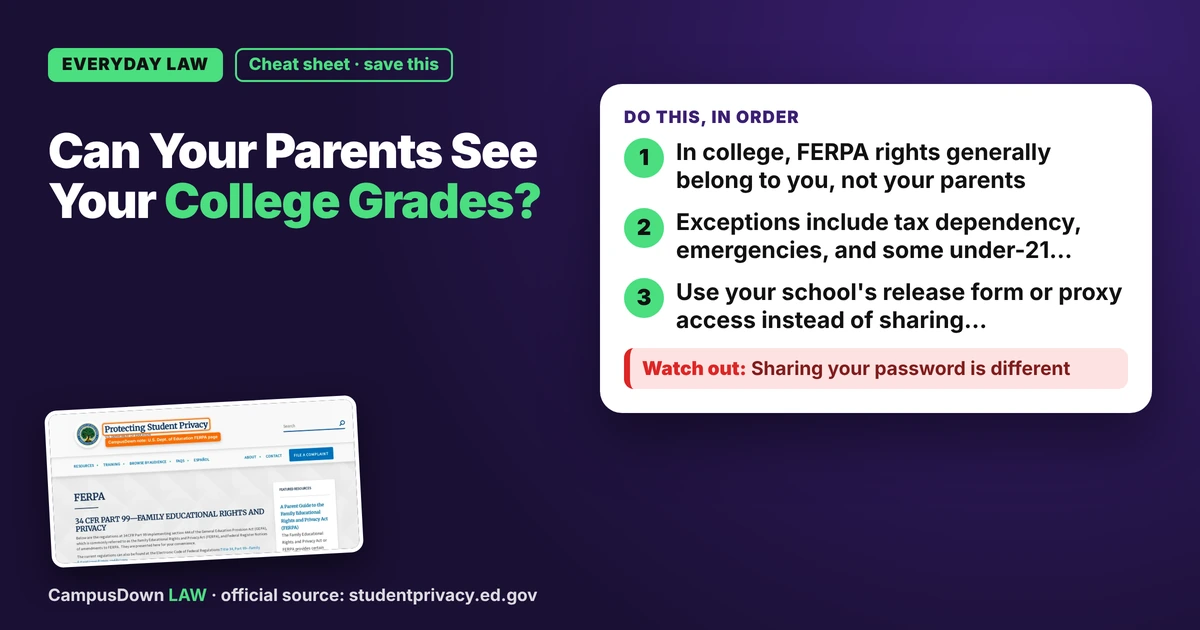
- In college, FERPA rights generally belong to you, not your parents.
- Exceptions include tax dependency, emergencies, and some under-21 alcohol or drug violations.
- Use your school's release form or proxy access instead of sharing passwords.
General information, not legal advice. Rules vary by state and can change; check the official sources linked in this guide.
My mom texted me: "Why can't I log into your student portal?" Which was followed, ten minutes later, by: "Call me." If you're wondering can my parents see my college grades, the answer is mostly about a federal law called FERPA, and it's more interesting than it sounds.
This is general information, not legal advice. Schools have their own policies within the law, so check yours too.
What FERPA is
The Family Educational Rights and Privacy Act (FERPA) is a federal law that protects the privacy of student education records at schools that receive federal education funding. In K-12, these rights belong to parents. When a student turns 18 or attends a postsecondary school at any age, the rights generally transfer to the student. That's why a college usually treats you as the one who controls your records.
It connects to broader privacy rights in the US, which are a patchwork of specific laws rather than one big rule.
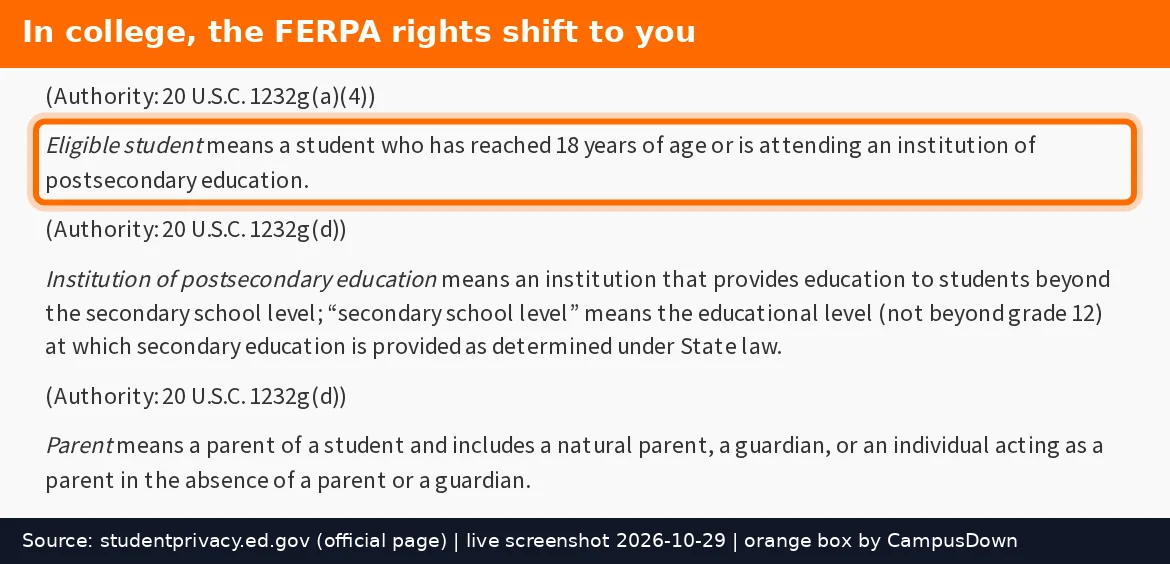
The U.S. Department of Education's Student Privacy office has an official FERPA page with the law, guidance, and FAQs. It's the source to check if your school says something that sounds off.
When a college can share without your consent
FERPA has exceptions. A college may (but isn't required to) disclose information to parents in some situations, including:
- If you're a dependent for federal tax purposes,* meaning your parents claim you on their taxes.
- Health or safety emergencies.*
- If you're under 21 and violated alcohol or drug rules* of the school or the law.
Schools can also share "directory information" (like your name, major and enrollment status) unless you opt out, depending on the school's policy.
Your other FERPA rights
- Inspect and review* your education records. Schools generally have to respond within 45 days of your request.
- Request a correction* if you think a record is inaccurate or misleading.
- File a complaint* with the Department of Education's Student Privacy Policy Office if you believe your rights were violated.
Talking to your parents about it
Here's the human side. Sometimes parents feel shut out, especially if they're paying. Some students choose to grant access, some share grades directly, and some decide some things are private. There's no single right answer.
The spotlight effect might make one bad grade feel like the end of the world. It isn't. And procedural justice applies at home too: a calm, fair conversation about who sees what usually goes better than a surprise.
Found this helpful? Share it with a friend who needs it.
Pick an app — it just sends the link, nothing else.
Frequently Asked Questions
Can my parents see my college grades without my permission?
Usually FERPA rights belong to the college student, but schools may share with parents in some cases, like if you're a tax dependent or there's a health or safety emergency.
At what age do FERPA rights transfer to the student?
When the student turns 18 or attends a postsecondary institution at any age.
How do I give my parents access to my college records?
Many schools have a FERPA release form or proxy access in the student portal where you choose what to share.
Where do I complain about a FERPA violation?
You can file a complaint with the U.S. Department of Education's Student Privacy Policy Office. This is general information, not legal advice.