My Engineering Class Idea Might Be Genius. Can I Actually Patent It?
Built something clever in a class project and wondering about a patent? A broke student's plain guide to ownership, public disclosure, and USPTO basics.
“Nearly re-enrolled in English class while reading a lease.”
Theology · Scripture Cards
Open a scripture card
Already read and shared by 315 people.
 I AM WHO I AM
Exodus 3:14
God said to Moses, “I AM WHO I AM,” and he said, “You shall tell the children of Israel this: ‘I AM has sent me to you.’ ”
Read this card
 Wings like Eagles
Isaiah 40:31
but those who wait for Yahweh will renew their strength. They will mount up with wings like eagles. They will run, and not be weary. They…
Read this card
 For Such a Time as This
Esther 4:14
For if you remain silent now, then relief and deliverance will come to the Jews from another place, but you and your father’s house will…
Read this card
 The God Who Brought You Out
Exodus 20:2
“I am Yahweh your God, who brought you out of the land of Egypt, out of the house of bondage.
Read this card
 Daughter, Your Faith Has Healed You
Mark 5:34
He said to her, “Daughter, your faith has made you well. Go in peace, and be cured of your disease.”
Read this card
 Listen to Him
Matthew 17:5
While he was still speaking, behold, a bright cloud overshadowed them. Behold, a voice came out of the cloud, saying, “This is my beloved…
Read this card
 The Lord Is My Shepherd
Psalm 23:1, 4
Yahweh is my shepherd; I shall lack nothing. … Even though I walk through the valley of the shadow of death, I will fear no evil, for you…
Read this card
 Not My Will, but Yours
Luke 22:42
saying, “Father, if you are willing, remove this cup from me. Nevertheless, not my will, but yours, be done.”
Read this card
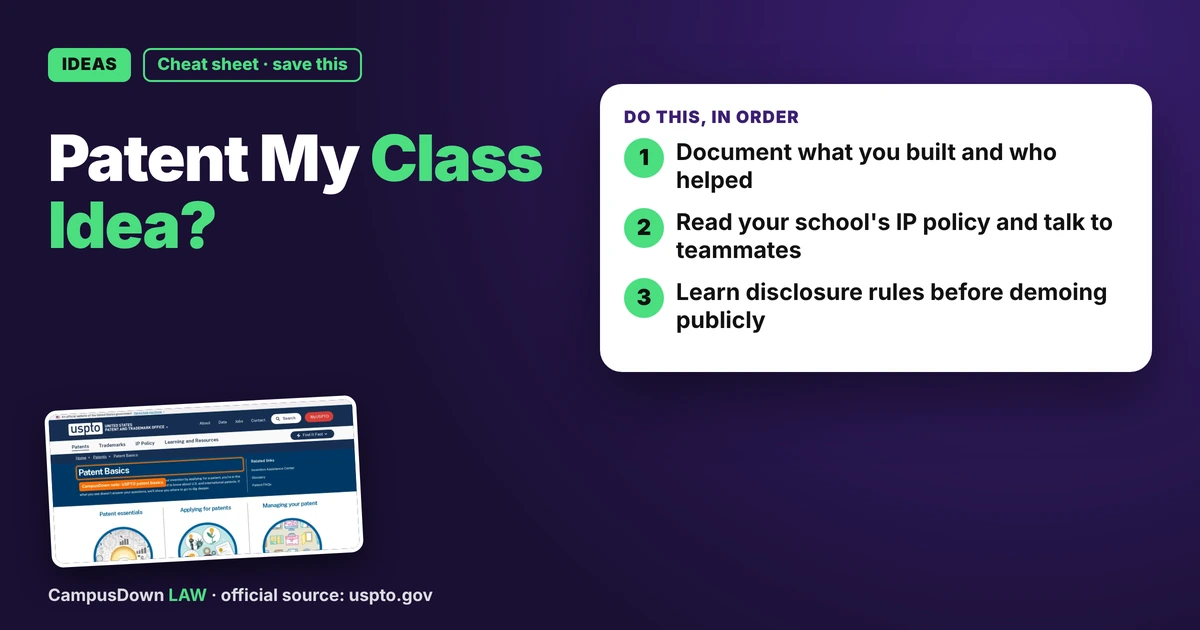
Key Takeaways
- Document what you built and who helped.
- Read your school's IP policy and talk to teammates.
- Learn disclosure rules before demoing publicly.
General information, not legal advice. Rules vary by state and can change; check the official sources linked in this guide.
It started at 2 a.m. in the maker lab. My team rigged a gadget for our design class, and somebody said, half joking, "Bro, we should patent this." Now I can't stop thinking about it. If you're also googling can i patent an idea from my college class project, welcome to the club of people who dream big on an instant-noodle budget.
Quick honesty check before we get excited: I'm a guy with a student ID and a search bar, not a patent attorney. What follows is general info I pieced together from official pages, and how it applies to you depends on your school, your team, and your idea.
An idea alone usually isn't enough
From what the USPTO explains, patents protect inventions, not vibes. A rough concept like "an app that makes dating less awkward" is not the same thing as a specific, working way of doing something. The wiki page on patentability requirements breaks down the usual tests in plain language, like whether the thing is new and not just an obvious tweak of something that exists.
So step one is boring but honest: write down exactly what your invention does and how it works. Sketches, code, dated notes. Future you will thank present you.
Who owns it: you, your team, or your school?
This part surprised me the most. Many universities have an intellectual property policy, and some cover stuff made with school labs, funding, or staff. Class projects are often treated differently from funded research, but policies vary a lot. Look up your school's IP policy and read it slowly, maybe with coffee.
Then there's the team. If four people built it, four people may have a claim. Talk about it now, while everyone is still friends and splitting pizza, not later when money shows up. A short written agreement among teammates is a lot less awkward than a group chat meltdown.
Careful what you post
Here's the trap: showing your invention publicly, like a demo video, a poster session, or a pitch competition, can affect your ability to get a patent, and rules on timing differ between countries. The USPTO patent basics page is the official starting point for learning how the process works, including the types of applications. Read it before you go viral on TikTok.
Money talk for broke inventors
Patents can get expensive between filing fees and professional help. Before panicking, check whether your campus has a tech transfer office, an entrepreneurship center, or a law school clinic that works with student inventors. Some offer free consults. The USPTO site also points to programs that help independent inventors, so poke around there.
Also, watch out for companies that promise to "market your invention" for a big upfront fee. The wiki entry on patent trolls is a different problem, but it's a good reminder that the patent world has sharks. Keep your guard up, and remember the idea of optimism bias: every inventor thinks their idea is the next big thing.
My plan, if this ever goes somewhere
- Write a clear description and keep dated files.
- Read my school's IP policy.
- Have the "who owns what" chat with the team.
- Hold off on public demos until I know more.
- Book a free consult on campus if one exists.
Maybe this gadget flops. Maybe it ends up in a store and I finally take someone nice to a dinner that isn't from a vending machine. Either way, knowing the basics beats guessing.
Know someone stuck with a landlord or billing problem? Pass this along.
Pick an app — it just sends the link, nothing else.
Frequently Asked Questions
Can I patent just an idea?
Generally patents cover specific inventions, not bare ideas. The USPTO basics page explains what qualifies.
Does my university own my class project?
It depends on your school's IP policy and how the project was funded. Read the policy.
Should I post a demo online first?
Be careful. Public disclosure can affect patent rights, so learn the rules before posting.
Where can I get cheap help?
Check for a campus tech transfer office, entrepreneurship center, or law clinic.