I Work Part-Time and Go to School. Can I Get the Earned Income Tax Credit?
Working shifts and taking classes? A student's plain look at the Earned Income Tax Credit, dependency questions, and where to check eligibility for free.
“Nearly re-enrolled in English class while reading a lease.”
Theology · Scripture Cards
Open a scripture card
Already read and shared by 315 people.
 Let There Be Light
Genesis 1:3-4
God said, “Let there be light,” and there was light. God saw the light, and saw that it was good. God divided the light from the darkness.
Read this card
 God Shut the Lions’ Mouths
Daniel 6:22
My God has sent his angel, and has shut the lions’ mouths, and they have not hurt me, because innocence was found in me before him; and…
Read this card
 Water from the Rock
Exodus 17:6
Behold, I will stand before you there on the rock in Horeb. You shall strike the rock, and water will come out of it, that the people may…
Read this card
 The God Who Brought You Out
Exodus 20:2
“I am Yahweh your God, who brought you out of the land of Egypt, out of the house of bondage.
Read this card
 Listen to Him
Matthew 17:5
While he was still speaking, behold, a bright cloud overshadowed them. Behold, a voice came out of the cloud, saying, “This is my beloved…
Read this card
 Unto Us a Child Is Born
Isaiah 9:6
For a child is born to us. A son is given to us; and the government will be on his shoulders. His name will be called Wonderful Counselor…
Read this card
 Salvation Is of the Lord
Jonah 2:6, 9
I went down to the bottoms of the mountains. The earth barred me in forever; yet you have brought my life up from the pit, Yahweh my God. ……
Read this card
 Meant for Good
Genesis 50:20
As for you, you meant evil against me, but God meant it for good, to save many people alive, as is happening today.
Read this card
Key Takeaways
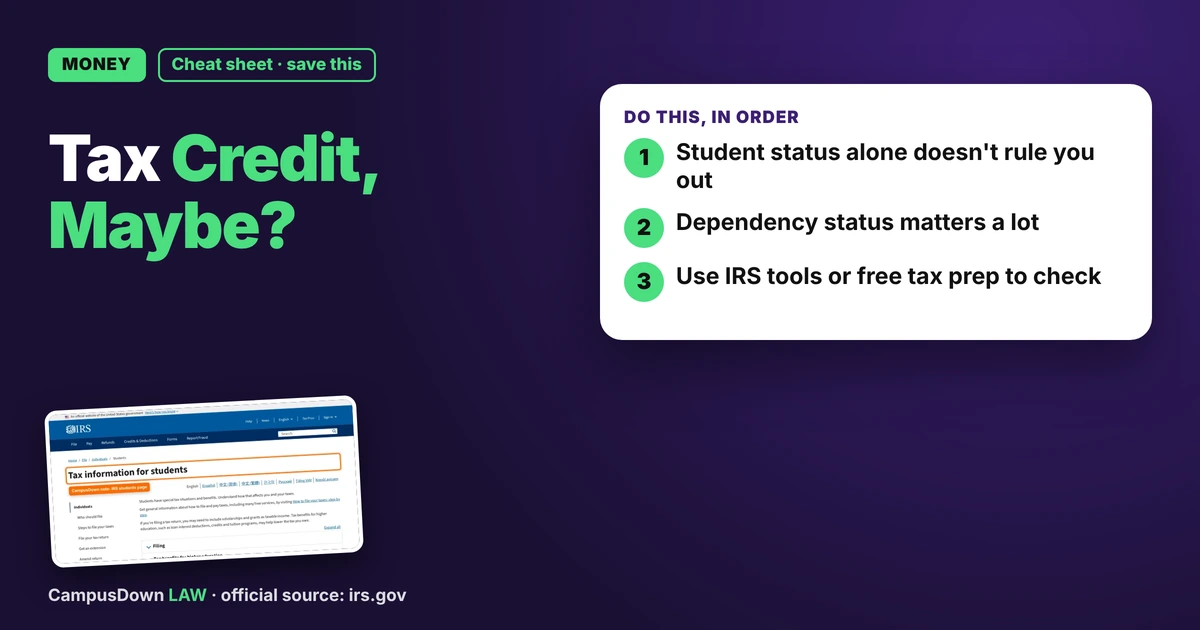
- Student status alone doesn't rule you out.
- Dependency status matters a lot.
- Use IRS tools or free tax prep to check.
General information, not legal advice. Rules vary by state and can change; check the official sources linked in this guide.
I work twenty-ish hours a week at a campus café and still have to choose between groceries and a new pair of jeans. So when a coworker mentioned "EITC," I perked up like a dog hearing the treat bag. If you're searching can a working college student claim the earned income tax credit, let's walk through it.
Not tax advice, just what I learned reading IRS pages in the laundromat. Tax rules change and depend on your full situation.
What the credit is
The wiki on the earned income tax credit explains it as a credit for working people with low to moderate income. It can lower your tax and sometimes create a refund. Economists talk about it as a work-based support, kind of a cousin to the idea of a negative income tax.
The student catch
Being a student doesn't automatically disqualify you, but some rules can trip students up:
- Age rules apply if you don't have qualifying children.
- If someone else can claim you as a dependent, that can block it.
- Being a full-time student can affect some age-related rules.
- Income limits and investment income limits apply.
I'm not listing exact ages or dollar limits here because they change. The IRS publishes current numbers each year.
Where to check for real
The IRS page for students links to tax topics that come up for people in school, and the IRS has an EITC eligibility assistant on its site. Free tax prep programs, often run on campus or at libraries, help lots of students figure this out.
If you want the bigger picture of how much tax you actually pay, the wiki on marginal and effective tax rates is a nice explainer.
Watch out for scams
Some "tax help" services promise giant refunds for a big fee. If something sounds too good, it might be. Use the IRS site directly or a free program you can verify. Never let someone file using made-up income or fake dependents. That can come back on you.
Don't leave money on the table
Even if you don't owe tax, filing might be worth it to get back withholding or claim credits you qualify for. That money could cover textbooks, or a dinner that isn't eaten standing over the sink. A guy can dream.
Legal stuff is easier with a friend. Send this to someone who could use it.
Pick an app — it just sends the link, nothing else.
Frequently Asked Questions
Can college students get the EITC?
Some can. Age, dependency status, income, and student status all matter. Check the IRS rules.
Does my parents claiming me matter?
Yes. If someone can claim you as a dependent, it can affect eligibility.
Where can I check if I qualify?
The IRS has an EITC tool and student pages. Free tax prep sites can help too.
Do I need to file if I didn't earn much?
Sometimes filing gets back withholding or credits. Check IRS guidance.